Reverse Sales Tax Calculator
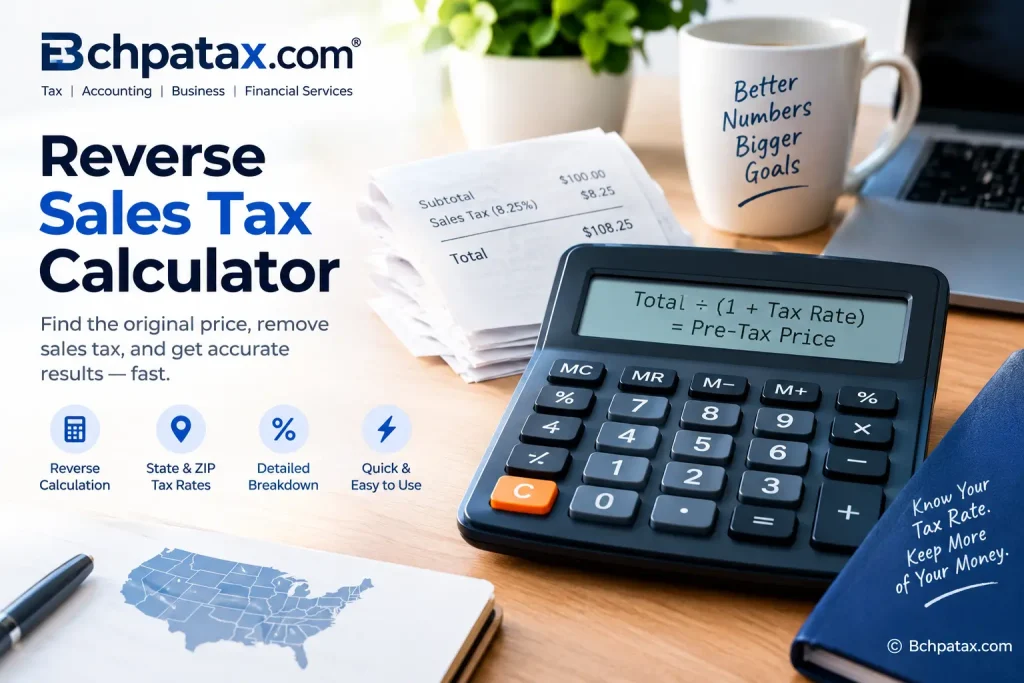
Free sales tax tool
Reverse Sales Tax Calculator
Enter the total you paid and your sales tax rate to find the price before tax and the sales tax included in the total.
Enter your numbers above and your result appears here instantly.
Show calculation
Sales tax rates and taxability rules can vary by jurisdiction, transaction type, and effective date. Use the rate returned by a verified lookup when available, or enter the rate shown on your receipt or invoice. For filing or compliance decisions, confirm the applicable rules with the relevant tax authority or a qualified tax professional.
How to Use the Reverse Sales Tax Calculator
Enter the total you paid, enter the sales tax rate, and read the price before tax. The calculator also shows how much of your total was tax.
- Enter the total amount, tax included.
- Enter the combined sales tax rate from your receipt or tax authority.
- Optional: open the state reference panel to see published state and average local rates.
- Read the price before tax and the sales tax included.
The math runs in your browser. Nothing you type is sent anywhere.
How to Calculate Sales Tax Backwards
Sales tax is one of those things that looks simple until a receipt refuses to add up. Going backwards takes two steps.
Price before tax = Total ÷ (1 + tax rate ÷ 100)
Sales tax = Total − Price before tax
Here is a worked example. Say your total is $108.25 and the combined rate is 8.25%.
- $108.25 ÷ 1.0825 = $100.00 before tax
- $108.25 − $100.00 = $8.25 in sales tax
This example is only arithmetic. It does not mean 8.25% applies to your purchase or your location.
Why Can’t You Just Subtract the Sales Tax?
The most common mistake is taking 8.25% off the total. It feels logical, and it gives the wrong answer.
- Wrong: $108.25 − 8.25% = $99.32
- Right: $108.25 ÷ 1.0825 = $100.00
The seller calculated the tax on the price before tax, not on the final total. The 8.25% was applied to $100.00. When you take 8.25% of $108.25, you take it from a bigger number, so you remove too much. Dividing undoes the original multiplication exactly.
Tax-Exclusive vs. Tax-Inclusive Prices
A tax-exclusive price does not include sales tax. Most U.S. shelf prices work this way, and tax is added at checkout.
A tax-inclusive price already contains the tax. Your receipt total is tax-inclusive, and so are some invoices and some all-in prices. The reverse calculator starts from a tax-inclusive amount and separates the tax from the net price.
Sales Tax Rates Vary by State and Location
The United States has no single sales tax rate. States set their own rules, and many allow counties, cities and special districts to add more.
The Tax Foundation’s midyear 2026 data shows how wide the range is. Forty-five states levy a state-level sales tax, and 38 states allow local sales taxes, including Alaska. Five states have no statewide sales tax: Alaska, Delaware, Montana, New Hampshire and Oregon. Of those five, only Alaska allows local sales taxes.
That does not mean every purchase in those states is tax-free. Alaska’s local taxes can apply, and special or resort-area taxes may exist elsewhere. Four terms matter here:
- Statewide rate: the rate the state sets.
- Local rate: what a county, city or district adds.
- Combined rate: state plus local. This is the number you want for the calculator.
- Taxability: whether the item is taxed at all, or taxed at a different rate.
The Tax Foundation also publishes population-weighted averages. Those describe a state overall. They are not the rate on any single receipt. For example, Washington’s average combined rate is 9.57% in that dataset, but the rate you actually paid depends on where the sale was sourced.
Can a ZIP Code Tell You the Exact Sales Tax Rate?
Not reliably on its own. A ZIP code is a mail-delivery area. It can cross city or county lines, and the tax boundaries do not follow postal routes. One ZIP code can contain more than one tax jurisdiction.
A ZIP code is a useful clue about where a sale happened. It is not proof of the rate. For an exact answer, you need address-level data from a maintained tax-rate provider or from your state revenue department.
That is why this calculator does not guess a rate from a ZIP code. If it cannot verify the rate, it asks you to enter the combined rate from your receipt or from an authoritative source. A wrong rate gives a confident, wrong answer, and we would rather not do that to you.
How to Remove Sales Tax From a Receipt
You need two things: the final receipt amount and the rate that was charged. Many receipts print the tax line, and some print the rate. If the receipt shows the tax amount and the pre-tax subtotal, you can use the “Find rate” tab to confirm the rate.
Watch for receipts with mixed items. Groceries, prepared food and household goods may be taxed differently on the same receipt. A single reverse calculation only works if one rate applies to the whole amount. When items differ, work each taxed line separately.
Where Bookkeepers and Business Owners Use It
Reversing tax out of a total comes up often in day-to-day accounting work:
- Separating the taxable amount from the tax on a card receipt
- Reconciling an expense report against a bank or card statement
- Checking whether a vendor invoice charged the right amount
- Working out reimbursement amounts
- Reviewing old purchase records when only totals were saved
How you record the tax depends on your situation. Some businesses can recover sales tax they paid. Others record it as part of the cost of the purchase. Your accountant can tell you which applies, and our bookkeeping services for small businesses page explains how clean records make that decision easier. If you are comparing firms, see our guide to accounting firms in California.
Sellers have a different job. If you collect sales tax, rates, nexus and sourcing rules can change what you owe and where. Florida businesses can start with our overview of tax services in Florida.
Common Mistakes
- Subtracting the tax percentage from the total instead of dividing
- Using a state base rate when local tax also applied
- Treating a state average as the rate on your receipt
- Assuming every item on a receipt is taxable
- Forgetting that rates change, often in January and July
- Treating a ZIP code as a guaranteed tax jurisdiction
- Rounding the rate or the result too early
On rounding: this calculator works in whole cents and calculates the tax as the remainder, so the pre-tax price plus the tax always equals your total.
Who Can Use a Reverse Sales Tax Calculator?
Anyone holding a tax-inclusive amount can use it.
- Consumers check how much of a purchase was tax.
- Small-business owners and freelancers separate costs from tax for their records.
- Bookkeepers and accountants reconcile receipts and clean up books.
- Retailers and e-commerce sellers check that checkout totals match their pricing.
- Finance teams and expense administrators review reimbursements and card statements.
It is a calculator, not tax advice. It does not decide what is taxable, and it does not replace a qualified professional. If your situation involves multiple states, exemptions or filing questions, talk to someone who knows your facts. You can start with professional tax preparation services, or read our tax and accounting blog for more guides.
A Quick Note on Federal Taxes
This calculator is not a deduction tool. The IRS does let some itemizers deduct state and local general sales taxes instead of income taxes, using actual receipts or optional tables. See the IRS page on deductible taxes for the rules and limits. Sales tax is also different from VAT, excise tax and property tax, and this tool handles only a single percentage sales tax.
Frequently Asked Questions
What is a reverse sales tax calculator?
It takes a total that already includes sales tax and works backward to the price before tax and the tax amount.
How do I calculate sales tax backwards?
Divide the total by 1 plus the tax rate as a decimal. Then subtract that result from the total to get the tax.
How do I remove sales tax from a total?
Use the same formula. At 8.25%, divide the total by 1.0825. The result is the amount before tax.
What is the formula for reverse sales tax?
Price before tax = Total ÷ (1 + rate ÷ 100). Sales tax = Total − Price before tax.
Why do I divide instead of subtracting the tax rate?
The seller applied the rate to the pre-tax price, not to the total. Dividing reverses that step. Subtracting a percentage of the total removes too much.
Can I calculate sales tax from a receipt?
Yes, if you know the rate that was charged and one rate applies to the whole amount. If the receipt lists the pre-tax subtotal and the tax, the “Find rate” tab can confirm the rate.
Does every U.S. state have the same sales tax?
No. Rates and rules differ by state. Per the Tax Foundation, five states have no statewide sales tax, and local rates add more variation.
Can I use my ZIP code to find sales tax?
A ZIP code can help locate a sale, but it does not reliably identify the full tax jurisdiction. Use the rate on your receipt or a verified source for your exact address.
Do local sales taxes affect the calculation?
Yes. Enter the combined state and local rate. Using only the state rate can overstate the price before tax.
Are all products and services taxed the same way?
No. Groceries, clothing, digital goods, services and prepared food can be taxed differently or exempt, depending on the jurisdiction.
Can businesses use a reverse sales tax calculator?
Yes, for bookkeeping checks, reconciliation and invoice review. Confirm how to record the tax with your accountant.
Is the calculator suitable for tax filing?
Use it as a checking tool. For returns and compliance decisions, rely on your records, your state’s rules and a qualified tax professional.
Sources
- Tax Foundation: State and Local Sales Tax Rates, Midyear 2026 (rates as of July 1, 2026)
- IRS Topic No. 503, Deductible taxes