Common Fixed Asset Accounting Mistakes to Avoid
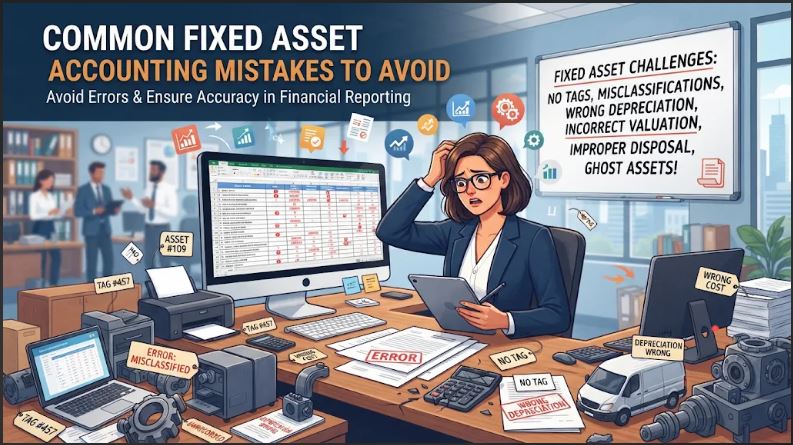
Fixed asset accounting becomes difficult once a business has hundreds of assets acquired at different times, transferred between locations, improved, partially disposed of, or used for both book and tax purposes.
Errors can affect depreciation expense, asset balances, tax calculations, and financial reporting for years. A reliable process starts with consistent capitalization rules, complete asset records, and clear procedures for changes that occur after an asset enters service.
Capitalizing the Wrong Costs
One of the most common mistakes is treating every purchase the same way.
A company may expense an item that should be capitalized, or capitalize ordinary repair costs that should have been recognized as current-period expenses.
The distinction depends on what the expenditure does. Costs that acquire an asset or materially improve its useful life, capacity, or functionality may require capitalization, while routine maintenance generally follows different treatment.
For tax purposes, the IRS also distinguishes repairs from improvements. Publication 946 explains that an improvement that betterments property, restores it, or adapts it to a new use must generally be treated as separate depreciable property.
A documented capitalization policy helps reduce inconsistent judgment between departments.
Using Incomplete Asset Records
A fixed asset register should contain more than the purchase price and asset name.
For each asset, the accounting team should be able to determine when it entered service, where it is located, which department owns it, how it is being depreciated, and whether it remains in use.
As asset volume grows, spreadsheets can become difficult to control. Accountants managing several entities, locations, asset classes, or depreciation books may use fixed asset software for accountants to maintain depreciation schedules, transfers, disposals, and reporting in a centralized system.
At minimum, the asset record should include:
- Original cost and capitalized additions
- Acquisition and placed-in-service dates
- Asset class and useful life
- Depreciation method
- Accumulated depreciation
- Location and responsible department
- Disposal or retirement information
Complete records make later calculations and reviews far easier.
Starting Depreciation on the Wrong Date
Purchase date, invoice date, payment date, and placed-in-service date are not necessarily the same.
For U.S. tax purposes, the IRS states in Publication 946 that depreciation begins when property is ready and available for its intended use.
Consider equipment purchased in December but not installed and operational until February. Starting depreciation in December simply because that is when the invoice was recorded can create an incorrect schedule.
Accounting teams should capture the actual placed-in-service date during asset setup rather than defaulting to the invoice date.
Choosing the Wrong Useful Life or Depreciation Method
Useful life directly affects periodic depreciation expense.
If an asset is assigned a life that is too short, expense is accelerated. If the life is too long, carrying value may remain overstated relative to the asset’s economic usefulness.
Book depreciation should reflect the applicable accounting policy and expected consumption of economic benefits. Tax depreciation follows separate rules.
The IRS notes that MACRS is generally used for most depreciable property for federal income tax purposes, with recovery periods determined by property class and the depreciation system applied.
Using a tax recovery period automatically as the book useful life can therefore produce inaccurate financial reporting.
Keep Book and Tax Schedules Separate
Book and tax depreciation may differ because of recovery periods, depreciation methods, conventions, Section 179 deductions, bonus depreciation, or other tax rules.
Maintain separate schedules where necessary rather than forcing both calculations into the same depreciation book.
This also makes tax provision and deferred-tax reconciliation easier.
Failing to Update Assets After Improvements
Asset accounting does not end when an item is first entered into the register.
A major renovation, equipment upgrade, component replacement, or other capital improvement may change the asset’s recorded cost or create a separate depreciable asset.
The accounting team needs enough information to determine whether the expenditure is a repair, a capital improvement, or a replacement of an existing component.
Without that review, a business can continue depreciating an old component while also capitalizing its replacement.
For larger projects, reconcile project invoices and completed work before transferring costs into the fixed asset register.
Mishandling Disposals and Retirements
Assets are sometimes sold, scrapped, abandoned, or replaced without accounting being notified.
When that happens, the asset may continue appearing on the books even though it is no longer owned or in service.
A disposal process should capture the asset ID, retirement date, proceeds, reason for disposal, and required approval. Accounting can then remove both the asset cost and accumulated depreciation and recognize any resulting gain or loss.
This process is especially important for assets that move frequently or are replaced in batches, such as laptops, vehicles, and field equipment.
Skipping Physical Verification
The fixed asset register should periodically be compared with actual assets.
A physical count can identify equipment that has moved, disappeared, been duplicated in the system, or been assigned to the wrong location.
Asset tags, serial numbers, barcodes, or other unique identifiers make verification more efficient.
Differences should be investigated before records are changed. A missing item may indicate an unrecorded disposal, transfer error, or custody issue rather than a simple data-entry problem.
Failing to Reconcile the Subledger to the General Ledger
Physical verification confirms that assets exist. General ledger reconciliation answers a different question: whether the accounting records agree.
The fixed asset subledger should reconcile to the corresponding cost and accumulated depreciation accounts.
Differences can arise when additions are posted directly to the general ledger, depreciation entries are duplicated, disposals are recorded in only one system, or capital projects are not transferred correctly.
A monthly or quarterly reconciliation should compare beginning balances, additions, transfers, disposals, depreciation, and ending balances.
Investigating discrepancies while they are still recent is much easier than reconstructing several months of activity at year-end.
Treat Fixed Asset Accounting as an Ongoing Process
Most fixed asset errors are not caused by difficult calculations. They come from incomplete information, inconsistent classification, and changes that are not reflected in the accounting records.
A sound process should determine what gets capitalized, capture the correct placed-in-service date, apply appropriate useful lives, separate book and tax calculations where needed, and update records when assets are improved, moved, or retired.
Those controls support accurate depreciation, cleaner financial statements, better tax records, and a fixed asset register that management can actually rely on.