IRS Code 806: What It Means on Your Tax Transcript
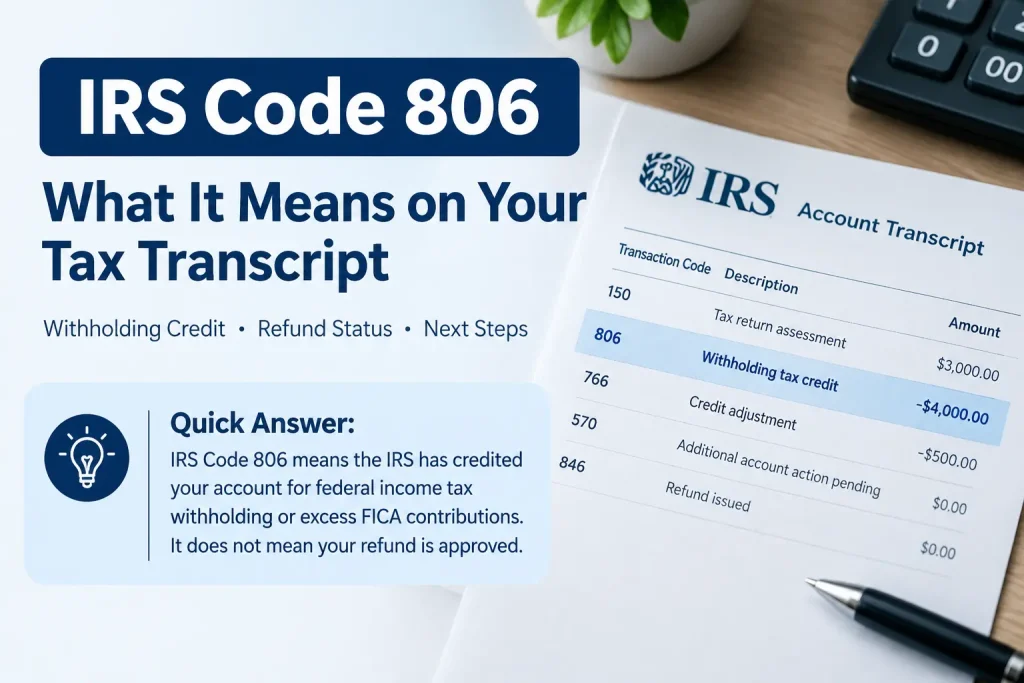
If you see IRS Code 806 on your tax transcript, it usually means the IRS has credited your account for federal income tax withholding or excess Social Security tax (FICA). This credit helps the IRS calculate your final tax balance.
However, Code 806 does not mean your tax refund has been approved. It also does not show how much money you will receive. To understand your refund status, you must check the other transaction codes on your IRS Account Transcript.
In this guide, you will learn what Code 806 means, why the amount is negative, what the date tells you, and how it relates to Codes 846, 570, and 766.
IRS Code 806: Key Takeaways
- Meaning: IRS Code 806 records a credit for withholding taxes and/or excess FICA contributions.
- Negative amount: This usually represents a credit applied to your tax account, not additional tax owed.
- Refund approval: Code 806 alone does not confirm that your refund has been approved or issued.
- Code 846: This is the transaction code associated with a refund issuance.
- Code 570: This indicates that additional account action is pending.
- Next step: Review your full IRS Account Transcript and check your refund status through the official IRS website.
Note: Always interpret transaction codes in the context of your complete tax account.
What Does Code 806 Mean on a Tax Transcript?
Code 806 on a tax transcript represents a credit for withholding taxes and/or excess FICA contributions. These amounts may come from federal income tax withheld from your wages or other payments.
For example, your employer may withhold federal income tax from your paycheck throughout the year. The amount withheld is reported to the IRS and applied toward your federal tax account.
When the IRS posts this credit, it may appear as transaction Code 806 on your account transcript.
Here is what you should know:
- Code 806: Records a withholding tax or excess FICA credit.
- Negative amount: Usually represents a credit applied to your tax account.
- Transaction date: Shows the date associated with the posted transaction. It is not necessarily your refund date.
- Refund status: Code 806 alone cannot confirm that the IRS has approved or issued your refund.
Therefore, seeing Code 806 is generally a normal part of your tax account record. However, you should review the full transcript to understand your current tax balance.
Is IRS Code 806 Good or Bad?
IRS Code 806 is generally a routine tax credit entry. It does not automatically indicate a tax problem or a refund approval.
A negative amount usually means the IRS has credited your account for withholding or excess FICA contributions. This credit helps determine whether you have paid enough tax for the year.
However, the code does not tell you the final result of your tax return.
For instance, your withholding may be greater than your final tax liability. In that case, you may qualify for a refund. On the other hand, your tax liability may be greater than your payments and credits, which could leave you with a balance due.
The key point: Code 806 records a credit. Your full account balance and other transactions determine what happens next.
Why Is IRS Code 806 a Negative Amount?
Many taxpayers worry when they see a minus sign beside Code 806. In most cases, there is no need to panic.
The IRS generally displays withholding credits as negative amounts on an account transcript. This sign convention shows that the amount is credited to your account rather than added as additional tax owed.
Example of a Negative Code 806 Amount
Suppose your account transcript shows the following entry:
| Transcript item | Example amount |
|---|---|
| Code 806 withholding credit | -$4,000 |
| Tax assessed under Code 150 | $3,000 |
| Simplified balance before other items | $1,000 credit |
In this example, the withholding credit is greater than the assessed tax amount. That may contribute to a refund.
However, this is only a simplified example. Other tax credits, payments, adjustments, and account transactions may affect your final balance.
A negative Code 806 amount does not guarantee that you will receive a $1,000 refund. You must review the complete transcript to understand the result.
What Does the Date Next to IRS Code 806 Mean?
The date beside Code 806 is associated with the transaction posted to your IRS account. It does not necessarily tell you when your refund will arrive.
Some taxpayers see a date such as April 15. This can reflect how the IRS applies tax payment dates for the relevant tax year.
Therefore, do not assume that the date beside Code 806 is your refund approval date or bank deposit date.
Instead, look for Code 846 to identify a refund issuance transaction. You can also check the IRS refund tracker for the latest available status.
If the date looks unusual, compare it with the tax year shown on your transcript. Remember that transaction dates and refund dates serve different purposes.
Does IRS Code 806 Mean My Tax Refund Is Approved?
No. IRS Code 806 does not confirm that your tax refund has been approved or issued.
It records a withholding credit. The IRS uses this credit, along with your tax liability and other payments, to calculate your account balance.
To understand your refund status, review the other codes on your IRS transcript.
For example:
- Code 806 records a withholding credit.
- Code 766 records a credit adjustment.
- Code 570 indicates additional account action is pending.
- Code 846 records a refund issuance transaction.
If Code 846 appears on your transcript, review its date and compare it with your refund status information. The actual date you receive the money can depend on the payment method and other factors.
If Code 846 does not appear, Code 806 alone cannot tell you when a refund will be issued.
IRS Code 806 vs. Other IRS Transcript Codes
Your IRS Account Transcript may contain several transaction codes. Each code records a different type of account activity.
Understanding these codes can help you avoid confusion when checking your refund.
Common IRS Transcript Codes Explained
| IRS Code | Meaning | What It Tells You |
|---|---|---|
| 150 | Tax return assessment | Records a tax assessment transaction on your account. |
| 806 | Withholding tax or excess FICA credit | Records the applicable withholding credit on your account. |
| 807 | Reversal of withholding credit | Records a reversal of a previously posted withholding credit. |
| 766 | Credit adjustment | Records a credit allowance or adjustment on the account. |
| 570 | Additional account action pending | Indicates that further account action is pending. |
| 571 | Hold resolved or released | May indicate resolution of a previously pending account action. |
| 810 | Refund freeze | Indicates a refund freeze on the account. |
| 846 | Refund issued | Records a refund issuance transaction and its associated date. |
Important: These descriptions are summaries. Review the complete transcript and official IRS transaction-code guidance before drawing conclusions about a specific account.
These codes do not always appear in the same order. Their meaning depends on the full account history and the tax year involved.
What Does IRS Code 806 With Code 846 Mean?
If your transcript shows Codes 806 and 846, they represent two different events.
Code 806 records a withholding credit. Code 846 records a refund issuance transaction.
Seeing both codes may help explain how your account moved from recorded credits to a refund issuance. However, the exact refund amount may also reflect other credits, payments, adjustments, or offsets.
Check the date beside Code 846 and use the IRS refund tracker for the latest available information.
What Does IRS Code 806 With Code 570 Mean?
Code 806 with Code 570 means your account shows a withholding credit and an additional account action pending.
Code 570 may indicate that the IRS needs more time to process or review your account. However, the code alone does not tell you the exact reason for the delay.
If you see Code 570, take these steps:
- Review your full account transcript.
- Check your IRS Online Account for messages or notices.
- Confirm that your income and withholding records are accurate.
- Follow any instructions in an official IRS notice.
- Check your refund status for updates.
Do not assume that Code 570 means your return has been rejected. Follow the IRS instructions for your specific situation.
What Does IRS Code 806 With Code 766 Mean?
Code 806 records withholding tax or excess FICA credits. Code 766 records a separate credit adjustment to your account.
When both appear, they may contribute to the calculation of your final tax balance. However, the exact effect depends on the amounts and other transactions on your transcript.
Read each entry separately before drawing conclusions about your refund.
What If You Have IRS Code 806 but No Code 846?
If your transcript shows Code 806 but no Code 846, it means you can see a withholding credit but not a refund issuance transaction under Code 846 in the transcript you are viewing.
This does not automatically mean your refund has been denied. It also does not prove that the IRS is delaying your return.
Your account may still be processing, or other transactions may affect the final result.
Here is what you should do next:
- Check your refund status: Use the official IRS Where’s My Refund? tool.
- Review other codes: Look for Codes 150, 570, 571, 766, or 810.
- Check your tax year: Make sure you are viewing the correct account transcript.
- Review IRS notices: The IRS may ask for more information if action is needed.
- Verify your tax records: Compare the withholding credit with your W-2 and other relevant tax documents.
If the IRS requests documents or verification, respond according to the notice instructions.
What Should You Do After IRS Code 806?
Follow these steps to understand your transcript and check whether further action is needed.
Confirm the tax year, Code 806 amount, transaction date, and nearby entries.
Check your filed return against your W-2 and other relevant withholding documents.
Look for Codes 570, 571, 810, and 846 to understand other account activity.
Use the official IRS refund tracker if you are expecting a refund.
If the IRS requests information, follow the instructions and deadlines in the notice.
Why Does Code 806 Not Match My Tax Return?
Sometimes, the amount beside Code 806 may not match the withholding amount you expected. This can happen for several reasons.
1. Your Withholding Figures May Be Incorrect
You may have entered an incorrect amount when preparing your tax return. Compare the withholding information on your filed return with your original tax documents.
2. You May Have a Corrected W-2
Your employer may issue a corrected Form W-2 after the original form was filed. As a result, the records available to the IRS may differ from the figures you first reported.
3. A Tax Document May Be Missing or Incorrect
A W-2 or another form reporting federal withholding may contain incorrect information. Contact the payer or employer if you find an error.
4. You May Be Comparing Different Tax Figures
Not every tax payment appears under Code 806. For example, estimated tax payments and withholding credits are recorded differently.
Make sure you are comparing the same type of payment and the same tax year.
How to Check a Code 806 Mismatch
Follow these steps to investigate a difference:
- Open your filed federal tax return.
- Review the federal income tax withholding reported on Form 1040.
- Compare that amount with your W-2 and any other relevant withholding statements.
- Check your IRS Account Transcript for additional credit or adjustment entries.
- Contact the employer or payer if a source document appears incorrect.
- Follow any instructions in an IRS notice if the IRS requests clarification.
Do not change your tax return based only on a transcript code. First, confirm the source of the difference and determine whether a correction is needed.
How Long After IRS Code 806 Will I Get My Refund?
IRS Code 806: What to Check Next
Use the other entries on your transcript to understand your account status.
A withholding tax or excess FICA credit is recorded.
Code 806 alone cannot confirm refund approval or issuance.
A refund issuance transaction is recorded. Review its date and check your refund status.
Additional account action is pending. Review your transcript and any IRS notices.
A refund freeze is recorded. Check official IRS instructions for your situation.
The transcript does not show a refund issuance entry under Code 846. Check your refund status for updates.
This guide is for general education. Transaction codes must be interpreted in the context of the complete account transcript.
There is no fixed number of days between Code 806 and a refund issuance.
Code 806 records a withholding credit. It does not start a guaranteed refund countdown.
Your refund timing depends on factors such as when the IRS processes your return, whether your account needs additional review, and whether other credits or adjustments apply.
If you want to check your refund status, use the official IRS tool:
Check your refund status with the IRS
The tool provides available refund status information. Follow its instructions to find out whether additional information is needed.
If your transcript shows Code 570 or Code 810, review your account and any IRS notices. These codes can indicate that further action or a refund restriction is involved.
Do not rely on online claims that your refund will arrive a specific number of days after Code 806 appears.
How to Get Your IRS Tax Transcript
If you want to understand Code 806, make sure you are viewing the correct transcript.
The IRS offers several transcript types. An Account Transcript is especially useful for reviewing account transactions and changes made after filing.
You can access your transcript through your IRS Online Account.
Follow these steps:
- Visit the official IRS Get Transcript page.
- Sign in to your IRS Online Account or follow the available access instructions.
- Select the appropriate tax year.
- Open your Account Transcript.
- Find Code 806 and review the date and amount.
- Check nearby transactions to understand the full account history.
The IRS also offers transcript access by mail and other methods. Availability depends on the transcript type and tax year.
Remember, a tax transcript is not a complete copy of your filed tax return. If you need to confirm a specific figure, compare the transcript with your original return and supporting tax documents.
Final Thoughts on IRS Code 806
IRS Code 806 is an important entry when you review your tax transcript. It records withholding tax or excess FICA credits applied to your account.
Although the entry is usually routine, it does not guarantee that your tax refund has been approved. You must review the other transactions and your overall account status to understand what happens next.
If you see Code 806, check the amount, date, and related transaction codes. Then compare the figures with your tax documents if anything looks incorrect.
For the most reliable information, use your IRS Online Account and the official IRS refund tracker. These resources can help you understand your account without relying on unsupported refund predictions.
Frequently Asked Questions About IRS Code 806
What does Code 806 mean on an IRS transcript?
Code 806 records a credit for withholding taxes and/or excess FICA contributions. It is part of your IRS account history and helps determine your tax balance. It does not, by itself, confirm that a refund has been approved.
What does IRS Code 806 mean on my tax transcript if the amount is negative?
A negative amount usually means the IRS has applied the withholding as a credit to your account. This credit reduces the balance that would otherwise be due. However, it does not guarantee a refund.
Is IRS Code 806 a good sign?
It is generally a routine credit entry. It can help explain the payments credited to your tax account. However, the code alone does not show whether your return is fully processed or whether a refund will be issued.
Does Code 806 mean my refund is approved?
No. Code 806 records a withholding credit. Code 846 is the transaction code associated with a refund issuance.
What does the date next to Code 806 mean?
The date is associated with the withholding credit transaction. It is not necessarily the date your refund was approved, issued, or deposited.
What if I see Code 806 and Code 570?
Code 806 records a withholding credit, while Code 570 indicates that additional account action is pending. Review your transcript and check for IRS notices to understand whether you need to take any action.
What if I see Code 806 but no Code 846?
Your transcript shows a withholding credit, but the transcript you are viewing does not show a refund issuance entry under Code 846. Check your refund status and review any other transaction codes before drawing conclusions.
Can IRS Code 806 change?
The IRS can make adjustments to a tax account when appropriate. If a withholding credit is reversed or adjusted, other transaction entries may appear. Review any changes carefully and follow official IRS instructions.
Does Code 806 include estimated tax payments?
Code 806 specifically relates to withholding tax and/or excess FICA contributions. Estimated tax payments are recorded separately. Therefore, do not assume that Code 806 includes every payment you made during the year.
Is Code 806 the same as Code 846?
No. Code 806 records a withholding credit. Code 846 records a refund issuance transaction. They serve different purposes on your IRS Account Transcript.
Disclaimer: This article is for general educational purposes only. It is not tax, legal, or financial advice. For questions about your specific tax account, consult a qualified tax professional or contact the IRS.