IRS Transcript Codes: Complete List and Meanings
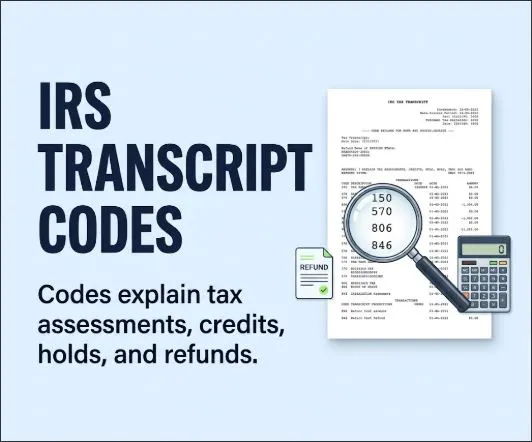
IRS transcript codes help explain activity on your federal tax account. Each transaction code identifies a specific type of action, such as a tax assessment, credit, refund, payment, or account hold. The code, date, amount, and other entries help you understand what happened to your account.
For example, IRS code 150 relates to a tax return assessment, code 806 records a withholding credit, code 570 can indicate a pending account action, and code 846 records a refund issued. However, one code does not always explain your full tax situation.
This guide explains common IRS transcript codes in simple terms. You will learn how to read the codes, understand refund-related entries, and find out what to check next.
Key Takeaways: IRS Transcript Codes
- IRS transcript codes record activity on your tax account, including assessments, credits, holds, and refunds.
- Code 150 relates to a tax return assessment.
- Code 570 can indicate a pending account action or credit hold. It does not automatically mean your refund was denied.
- Code 806 records certain withholding credits.
- Code 846 records a refund issuance, but does not confirm that the money reached your bank.
- Always review the code, date, amount, related transactions, and any IRS notice.
- Check the official IRS Document 6209 for processing references.
What Are IRS Transcript Codes?
IRS transcript codes are numbers used to record actions on your federal tax account. These are often called transaction codes or TC codes.
A transaction code can show that the IRS processed a return, added a credit, assessed tax, changed an account, or recorded a refund. Some codes may also relate to notices, examinations, or account holds.
Most transaction codes discussed in individual income tax guides have three digits. However, an IRS transcript can contain other codes, dates, descriptions, and account information.
The IRS publishes official processing guidance in Document 6209. This document contains transaction codes and other processing references. Some sections are technical and intended for IRS employees.
A taxpayer-friendly explanation can help you understand a code. Still, you should review the full transcript before deciding what the code means for your account.
IRS Transcript Codes List and Meanings
The table below covers common IRS transaction codes that individual taxpayers may encounter. It is a practical reference, not an exhaustive list of every code used by the IRS.
| IRS Code | Meaning | What It May Tell You |
|---|---|---|
| 150 | Tax return filed and tax liability assessed | The IRS recorded a return assessment. |
| 290 | Additional tax assessed or no additional tax assessed | Check the amount and related entries to understand the adjustment. |
| 300 | Additional tax assessed in certain circumstances | Review the account context and any related notice. |
| 420 | Examination indicator | The account may be associated with an examination process. |
| 424 | Examination request indicator | An examination-related request may have been recorded. |
| 460 | Extension of time to file | An extension-related entry was recorded. |
| 570 | Additional account action pending or credit hold | Further processing may be needed before the account is resolved. |
| 571 | Related account hold or freeze released or resolved | A related account restriction may have been resolved. |
| 582 | Federal tax lien indicator | A lien-related entry may have been recorded. |
| 601 | Abatement of a previously assessed penalty or interest in applicable cases | Check the transaction description and amount. |
| 604 | Overpayment credit transferred in applicable cases | Review the account entries to understand the transfer. |
| 766 | Credit to your account | A credit was recorded on the account. |
| 768 | Earned Income Credit | An Earned Income Credit-related entry was recorded. |
| 806 | Credit for withholding taxes and excess FICA | Withholding-related credits were recorded. |
| 810 | Refund freeze | A freeze may prevent the refund from being issued. |
| 811 | Refund freeze released | A related refund freeze may have been released. |
| 826 | Credit transferred out | A credit was transferred from the account. |
| 846 | Refund issued | The transcript records a refund issuance. |
| 898 | Refund applied to a non-IRS debt | All or part of a refund may have been applied to an eligible debt outside the IRS. |
| 971 | Miscellaneous transaction | The specific action depends on the associated action code and account context. |
Important: This table summarizes common uses of these codes. It does not replace the official IRS definitions. Some transaction codes have specific uses, conditions, or exceptions. Always check the full entry and relevant IRS guidance before deciding what happened to your account.
Common IRS Transcript Codes Explained
Some IRS transaction codes receive more attention because they can affect how taxpayers understand their refunds, credits, or account balances. The following sections explain the codes people often search for.
IRS Code 150: Tax Return Filed and Tax Liability Assessed
IRS code 150 generally means the IRS recorded the tax return assessment on your account.
This code does not automatically mean that your refund has been approved or issued. It also does not mean that you owe additional tax beyond what your return shows.
Check the amount next to code 150 and compare it with the information on your tax return. Then review any later transactions that may have changed your account balance.
IRS Code 290: Additional Tax Assessment
IRS code 290 relates to an additional tax assessment or a no-additional-tax-assessed transaction, depending on the entry.
The amount and surrounding transactions matter. A zero-dollar amount may appear in situations where no additional tax was assessed.
Do not assume that code 290 always means you owe more money. Review the full transcript and any IRS notice before taking action.
IRS Code 420: Examination Indicator
IRS code 420 is associated with an examination indicator. It can signal examination-related activity on the account.
This code alone does not tell you the final outcome of an examination. It also does not prove that the IRS has found an error.
Review your IRS correspondence and follow the instructions in any notice you receive. If you are unsure how to respond, consider contacting a qualified tax professional.
IRS Code 424: Examination Request Indicator
IRS code 424 is associated with an examination request indicator. It can appear during an examination-related process.
Do not treat code 424 as proof that an audit is complete or that additional tax is due. Check for later transactions and official IRS correspondence.
IRS Code 570: Additional Account Action Pending
IRS code 570 can indicate that additional account action is pending or that a credit hold applies.
Taxpayers often search for this code when their refunds have not arrived. However, the code alone does not explain the reason for the hold or show exactly when the refund will be released.
Check the following:
- The transaction date and amount.
- Any later codes on the same transcript.
- Whether the IRS has sent you a notice.
- The current status shown in the IRS refund tools.
If the account remains unresolved, follow any instructions in your notice or contact the IRS for information about your specific case.
IRS Code 571: Hold or Freeze Released
IRS code 571 can indicate that a related account hold or freeze has been released or resolved.
This may be a helpful sign when it follows code 570. However, the sequence does not guarantee that a refund will be issued immediately.
Look for later transactions, including a possible refund issuance entry. Also check your official refund status for the latest available information.
IRS Code 766: Credit to Your Account
IRS code 766 records a credit to your account. The credit may affect your account balance or the amount available to cover tax liabilities.
The code does not always mean that money will be deposited into your bank account. Other transactions may affect how the credit is applied.
Review the amount and related entries to understand the effect on your account.
IRS Code 768: Earned Income Credit
IRS code 768 is associated with the Earned Income Credit, also called the Earned Income Tax Credit or EITC.
The entry can help you identify an Earned Income Credit-related amount on your transcript. It does not, by itself, establish when a refund will arrive.
Check the credit amount and any other refund-related entries. If you need to confirm your refund status, use the IRS refund tools.
IRS Code 806: Withholding Credit
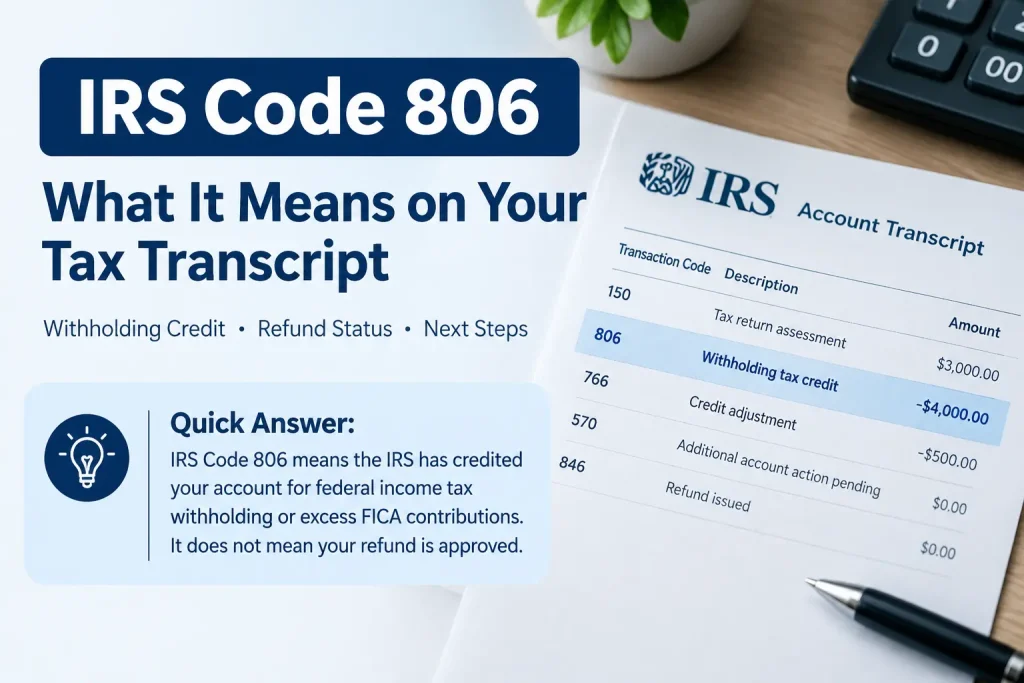
IRS code 806 records a credit for withholding taxes and excess Federal Insurance Contributions Act (FICA) taxes in applicable cases.
This entry may reflect tax withheld from wages or other withholding-related amounts. It is not the same as a refund issuance.
Review the amount and compare it with your tax return and other transcript entries. A withholding credit can be part of the calculation that determines whether you owe tax or receive a refund.
IRS Code 810: Refund Freeze
IRS code 810 is associated with a refund freeze. A freeze can prevent the IRS from issuing a refund while the account requires further action.
The code alone does not tell you why the freeze was placed. It also does not establish how long the review will take.
Check your IRS notices and any later transactions. If the IRS requests documents or information, follow the instructions and deadlines in the notice.
IRS Code 811: Refund Freeze Released
IRS code 811 can indicate that a related refund freeze has been released.
This may be an important update when code 810 appeared earlier. However, it does not guarantee that a refund has already been sent.
Check for code 846 or other relevant transactions and confirm the current status through the IRS refund tools.
IRS Code 826: Credit Transferred Out
IRS code 826 generally records a credit transferred out of an account.
A transfer may affect the balance shown for a tax year. It does not necessarily mean that the IRS has issued a refund to you.
Review the amounts and other account entries to understand where the credit was applied. Contact the IRS if the transfer is unclear or does not match your records.
IRS Code 846: Refund Issued
IRS code 846 means the IRS recorded a refund issuance on your transcript.
This is an important code for taxpayers who are waiting for a refund. The transaction generally includes a date and an amount that help explain the recorded refund.
However, code 846 does not prove that the money has already reached your bank account. Delivery can depend on the payment method and other factors.
Check the refund amount and date. If the money has not arrived within the expected period, use the IRS refund tools or follow the instructions provided by the IRS.
IRS Code 898: Refund Applied to a Non-IRS Debt
IRS code 898 can indicate that a refund was applied to a non-IRS debt through the applicable refund offset process.
This may affect the amount you receive. An offset can reduce the refund available for direct deposit or a paper check.
If you believe an offset is incorrect or need to know which agency received the funds, review the relevant notice and official offset information. Do not assume that the full refund amount will reach your bank account.
IRS Code 971: Miscellaneous Transaction
IRS code 971 is a miscellaneous transaction code. Its meaning depends on the associated action code and account context.
It is often discussed in connection with notices, but it should not automatically be interpreted as proof that a specific notice was sent or that a refund is delayed.
Review the full transcript and any IRS correspondence. If the action remains unclear, contact the IRS or a qualified tax professional for help understanding your account.
What Do IRS Transcript Codes 570 and 971 Mean Together?
IRS codes 570 and 971 can appear together on an account transcript. Taxpayers often search for this combination when they are waiting for a refund.
Code 570 can indicate a pending account action or credit hold. Code 971 identifies a miscellaneous transaction whose specific meaning depends on its action code and context.
When these codes appear together, review the dates, amounts, action details, and any IRS notice. The combination alone does not establish the reason for the hold or predict the refund date.
If you receive an IRS notice, follow its instructions. If you do not understand the account activity, contact the IRS for information specific to your tax year.
What Do IRS Transcript Codes 150 and 806 Mean Together?
Codes 150 and 806 can appear on the same transcript because they record different types of account activity.
Code 150 relates to a tax return assessment. Code 806 records a withholding credit in applicable cases.
These entries help show how tax and withholding information was recorded on your account. They do not, by themselves, establish the final refund amount or the date of payment.
Review the amounts and all later transactions to understand the account balance.
What Do IRS Transcript Codes 766 and 846 Mean Together?
Code 766 records a credit to your account, while code 846 records a refund issuance.
Seeing both codes may help explain how credits and a refund appear on the transcript. However, the exact effect depends on the amounts and the other transactions on the account.
Do not assume that the amount next to code 766 will match your refund. Compare the full transcript with your tax return and check the official refund status.
What Do IRS Transcript Codes 810 and 811 Mean Together?
Code 810 is associated with a refund freeze. Code 811 can indicate that a related freeze has been released.
If both appear on your transcript, review their dates and the other entries that follow them. The sequence may help you understand the account’s processing history.
A release does not always mean that a refund has been issued. Look for later transactions and check your official refund status.
How to Read an IRS Account Transcript
An IRS account transcript shows important information about your federal tax account. It can include your filing status, tax assessment, payment activity, credits, and changes made after you filed your return.
You can Read Your IRS Transcript in 5 Steps
Confirm the tax year
Make sure the transcript covers the tax year you want to review.
Find the transaction code
Locate the code and read the transaction description beside it.
Check the date and amount
These details help explain when the entry was recorded and how much it involved.
Read the surrounding entries
Earlier or later codes may change how you interpret a single transaction.
Review IRS notices
Follow any instructions or deadlines in official correspondence. Contact the IRS if you need case-specific information.
Follow these steps to read your transcript.
1. Confirm the Tax Year
Check the tax year shown on the document. Each account transcript covers a specific tax year.
Make sure you are reading the transcript for the return or payment you want to understand.
2. Find the Transaction Code
Look for the three-digit transaction code in the transaction section. Codes identify different types of account activity.
Use this guide to find the code’s general meaning. For an official definition, consult the applicable IRS processing reference.
3. Check the Transaction Date
The transaction date helps place the entry in the account’s timeline.
Do not assume that every date is a refund payment date. A transaction date may describe a recorded account event rather than the day money reaches your bank.
4. Review the Amount
Check the amount next to the code. It may represent a tax assessment, credit, payment, or refund.
A credit entry does not always mean a cash payment is coming. Read the amount alongside the code and related transactions.
5. Review Other Codes
One code may not explain the full situation. Later entries can show additional processing, account changes, or a refund issuance.
Look at the entries before and after the code you are trying to understand.
6. Check for IRS Notices
Some account activity may relate to a notice or request for information. Review any correspondence you have received.
If the IRS asks you to respond, follow the notice instructions and deadline.
What Is the Difference Between an IRS Transcript Code and a Cycle Code?
A transaction code and a cycle code serve different purposes.
A transaction code identifies an account event, such as a tax assessment, credit, hold, or refund issuance. A cycle code is associated with IRS processing information and can help identify a processing cycle.
Neither code should be used alone to promise an exact refund date. Check your account entries and the official IRS refund status for the most reliable information available.
How to Get Your IRS Tax Transcript
You can get an IRS transcript online or request certain transcript types by mail.
The IRS provides several transcript types. Each one serves a different purpose.
| Transcript Type | What It Shows |
|---|---|
| Tax return transcript | Most line items from the original return as filed, with certain related forms and schedules |
| Tax account transcript | Basic tax account information and changes made after filing |
| Record of account transcript | Combines return and account transcript information |
| Wage and income transcript | Information returns received by the IRS, such as Forms W-2 and 1099 |
| Verification of non-filing letter | Confirms that the IRS has no processed tax return record for the requested period, where applicable |
You can access transcripts through your IRS Individual Online Account. The IRS also provides mail and other request options for eligible transcript types.
If you need a transcript for a business, check the IRS instructions for business tax transcripts.
Remember that an account transcript may not show every recent or pending action. The IRS explains transcript types and access options in its official transcript guide.
What Should You Do If You Do Not Understand an IRS Transcript Code?
If you see an unfamiliar IRS transcript code, do not panic. A code is a record of account activity, not a complete explanation of your tax situation.
Use these steps to understand it:
- Confirm the tax year and transcript type.
- Find the code and read its transaction description.
- Check the date and amount.
- Review earlier and later entries.
- Look for IRS notices or requests for information.
- Use official IRS tools to check your refund or account.
- Contact the IRS or a qualified tax professional if you still need help.
Do not ignore an IRS notice with a response deadline. If the notice asks for information, follow its instructions.
Final Thoughts
IRS transcript codes help you understand the activity recorded on your federal tax account. They can show tax assessments, withholding credits, account holds, adjustments, and refund issuances.
The key is to read each code alongside its date, amount, and related transactions. A single code rarely explains every part of your tax situation.
If a code is unclear, check the official IRS guidance and review any notice you received. For personal account questions, use the IRS’s official tools or contact the agency directly. A qualified tax professional can also help you understand complex account activity.
Frequently Asked Questions About IRS Transcript Codes
What are the most common IRS transcript codes?
Commonly discussed codes include 150, 290, 570, 571, 766, 768, 806, 810, 811, 846, and 971. Each code has a specific use, and its meaning depends on the account context.
Which IRS transcript code means a refund was issued?
IRS code 846 records a refund issuance. Check the transaction date and amount, then use the official IRS refund tools to confirm the current status of your payment.
Does IRS code 570 mean my refund is denied?
No. Code 570 can indicate a pending account action or credit hold. It does not automatically mean your refund has been denied.
Does IRS code 971 always mean a notice was sent?
No. Code 971 is a miscellaneous transaction code. Its specific meaning depends on the associated action code and account context. Check your transcript and any IRS correspondence.
What does IRS code 806 mean?
Code 806 records a credit for withholding taxes and excess FICA taxes in applicable cases. It is a credit entry, not a refund issuance.
What does IRS code 766 mean?
Code 766 records a credit to your account. The credit may affect your tax balance or the amount available for a refund, depending on other account activity.
What does IRS code 810 mean?
Code 810 is associated with a refund freeze. It can prevent a refund from being issued while further account action is needed. The code alone does not explain why the freeze was placed.
What does IRS code 811 mean?
Code 811 can indicate that a related refund freeze has been released. It does not guarantee that the refund has already been issued or deposited.
Can IRS transcript codes tell me my exact refund date?
Not by themselves. Some entries show a refund issuance date, but other codes do not predict when a payment will arrive. Use the IRS refund tools for the latest available status.
Where can I find the official IRS transaction code list?
The IRS publishes Document 6209, which contains transaction codes and other processing references. You can find it through the IRS Document 6209 directory.