IRS Form 1099-R Distribution Code 8 Meaning: Excess Contributions
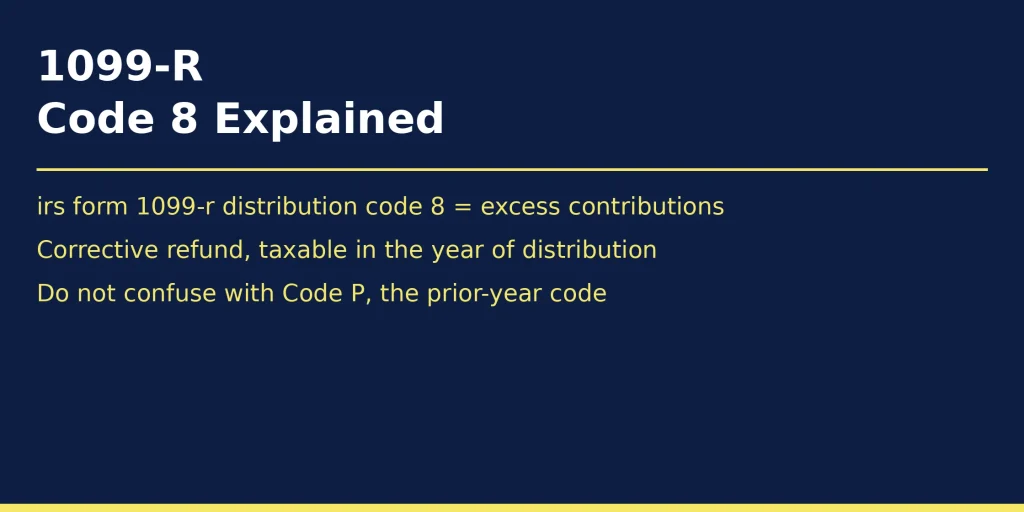
Direct answer: irs form 1099-r distribution code 8 means a corrective distribution of excess contributions plus earnings, or excess deferrals plus earnings, that is taxable in the year of distribution. It is the fix when you put too much into a plan or IRA. Code P, not Code 8, marks the same fix taxable in a prior year.
Key Takeaways
- irs form 1099-r distribution code 8 = excess contributions or deferrals plus earnings, returned as a correction.
- Code 8 is taxable in the year of distribution. On 2026 forms, that means taxable in 2026.
- Code P is the trap: it marks the same kind of refund taxable in a prior year, not the current year.
- Only three numeric pairs are allowed with Code 8: 8 with 1, 8 with 2, or 8 with 4.
- Box 2a shows the taxable part, usually the earnings. Report Box 2a, not the full Box 1.
- On 2026 forms the code sits in Box 7a, and Box 7d reports earnings on excess contributions.
irs form 1099-r distribution code 8: Excess Contributions
Form 1099-R reports money paid out of pensions, annuities, retirement plans, and IRAs. The payer files it for distributions of $10 or more. Box 1 shows the gross amount. Box 2a shows the taxable amount. The distribution code tells the IRS why the money was paid.
The IRS Instructions for Forms 1099-R and 5498 define the code as: “8 — Excess contributions plus earnings/excess deferrals (and/or earnings) taxable in 2026.” The instructions say to use Code 8 for a corrective IRA distribution under section 408(d)(4), unless Code P applies. They also say to use it for corrective distributions of excess deferrals, excess contributions, and excess aggregate contributions, unless Code P applies.
In plain terms, Code 8 is a correction. You, or your employer, put too much money in. The plan or IRA sends the excess back, with its earnings. The 1099-R records that return. It is not a normal payout, and it is not a rollover.
How Excess Contributions Happen
Excess contributions happen in a few common ways. You may exceed the annual IRA limit. You may contribute to a plan after changing jobs and losing track of the total. An employer plan may fail a test and return part of your deferrals. A contribution may be made to the wrong type of account.
The details differ, but the fix is the same shape: take the excess out, with the earnings it made while it sat in the account. The earnings are the taxable part in most cases. The excess contribution itself is often after-tax money already, or money that was never meant to be in the account. Box 2a sorts that out.
If an excess stays in the account past the correction deadline, a 6% excise tax may apply for each year it remains. That is why plans act fast, and why you should not ignore a Code 8 form. The correction deadline is usually your tax filing deadline, with extensions, for the year of the excess. Ask a tax professional if you missed that date.
Code 8 vs. Code P: The Year Trap
Code 8 and Code P describe the same kind of corrective refund. The difference is the tax year. Code 8 means the earnings are taxable in the year of distribution. Code P means they are taxable in a prior year, the year the contribution was made.
On 2026 forms, the split is clear. Code 8 says “taxable in 2026.” Code P says “taxable in 2025 or a previous year.” If you report a Code P amount in the wrong year, your return will not match the IRS record. If you report a Code 8 amount as prior-year income, the same mismatch happens.
Check the code letter before you enter anything. Do not assume a corrective refund belongs in the year you made the contribution. The code tells you which year the IRS expects. For a Code 8 form received in early 2027 for a 2026 distribution, the income belongs on your 2026 return.
Code 8 Pairing Rules
Code 8 can appear alone, or with a second code. The IRS allows only three numeric pairs: 8 with 1, 8 with 2, or 8 with 4. It can also pair with letter codes such as B, J, or K, which add detail about the account type.
The pair tells a fuller story. Code 8 with Code 1 means an excess refund to someone under 59½ with no known exception. Code 8 with Code 2 means the same refund, but an exception is known. Code 8 with Code 4 means an excess refund tied to a death payment. Read both codes together.
For the early-distribution pair, see IRS Form 1099-R Distribution Code 1 Meaning: Early Distribution, No Known Exception and IRS Form 1099-R Distribution Code 2 Meaning: Early Distribution, Exception Applies. For the death case, see IRS Form 1099-R Distribution Code 4 Meaning: Death Benefit.
Code 8 vs. Other 1099-R Distribution Codes
Code 8 is only one code in a longer list. The nearest neighbours are the ones readers confuse it with:
| Code | Meaning | When it appears |
|---|---|---|
| 8 | Excess contributions plus earnings, current year | Corrective refund taxable in the year of distribution |
| P | Excess contributions plus earnings, prior year | Same refund, taxable in the year the contribution was made |
| 7 | Normal distribution | At age 59½ or older, or when no other code applies |
| 1 | Early distribution, no known exception | Under 59½ with no exception the payer knows about |
| G | Direct rollover | Money moves trustee-to-trustee to another plan or IRA |
| H | Direct rollover of a designated Roth account | Designated Roth account money moves to a Roth IRA |
A Code 8 payment is not a rollover. Do not treat it like one. The money came back to you as a correction, and the taxable part in Box 2a is income now. A rollover, by contrast, moves money from plan to plan without you holding it. See IRS Form 1099-R Distribution Code G Meaning: Direct Rollover and IRS Form 1099-R Distribution Code H Meaning: Roth Rollover for that contrast.
| Check this | What it tells you |
|---|---|
| Is the code 8 or P? | 8 means current-year tax. P means prior-year tax. The year matters. |
| Is there a second code? | Only 8 with 1, 2, or 4 are allowed numeric pairs. Read both codes. |
| What is in Box 2a? | Box 2a is the taxable part, usually the earnings. Report that, not Box 1. |
| What is in Box 7d (2026)? | Box 7d reports earnings on excess contributions on 2026 forms. |
How to Report a Code 8 Payment
Work through the boxes in order:
- Box 1, gross distribution. This is the total corrective amount, excess plus earnings.
- Box 2a, taxable amount. Report this amount as income in the year of distribution.
- Box 4, federal income tax withheld. Claim this withholding on your return.
- Box 7a (2026) or Box 7 (earlier years), distribution code. Code 8 confirms a current-year corrective distribution.
- Box 7d (2026 forms only). This reports earnings on excess contributions. Compare it with Box 2a.
Report the 1099-R even when the taxable amount looks small. Leaving it off can trigger a notice proposing tax on the full Box 1 amount. The IRS receives its own copy, and a missing form looks like unreported income.
The money in a workplace plan first showed up on a W-2. For the pre-tax version, see IRS W-2 Box 12 Code D Meaning: 401(k) Elective Deferrals. For every W-2 code in one place, see W-2 Box 12 Codes Explained: Complete Guide.
What To Do When You See Code 8
Follow these steps, in order:
- Confirm the code is 8, not P. The tax year depends on that letter. Do not guess.
- Report Box 2a in the year of distribution. For a 2026 form, that is your 2026 return.
- Check whether a second code applies. An 8 with 1, 2, or 4 pair changes the penalty picture.
- Fix the cause, not just the form. Check next year’s contributions against the limit before they go in.
- Check your wage and income transcript if anything looks off. Pull it through the IRS Get Transcript tool and compare the figures to your 1099-R. If you are unsure how to read it, use How to Read an IRS Account Transcript: Step-by-Step Guide.
- Keep the 1099-R with your tax records. The IRS receives its own copy, and a mismatch can trigger a notice.
Once your return is filed, you can follow Tax Refund Status to track any refund. Any refund the IRS issues posts to your transcript as IRS Code 846: Refund Issued.
The official code list is in the IRS Instructions for Forms 1099-R and 5498. The W-2 code list is in the IRS General Instructions for Forms W-2 and W-3.
Related Guides
- IRS Transcript Codes: Complete List and Meanings
- IRS Form 1099-R Distribution Code 7 Meaning: Normal Distribution
- IRS Form 1099-R Distribution Code 4 Meaning: Death Benefit
- IRS Form 1099-R Distribution Code G Meaning: Direct Rollover
FAQ
What does irs form 1099-r distribution code 8 mean?
It means a corrective distribution of excess contributions plus earnings, or excess deferrals plus earnings, taxable in the year of distribution.
What is the difference between Code 8 and Code P?
Both mark corrective refunds of excess contributions. Code 8 is taxable in the year of distribution. Code P is taxable in a prior year, the year the contribution was made.
Is the full Box 1 amount taxable on a Code 8 form?
Usually not. Box 2a shows the taxable part, which is usually the earnings. Report Box 2a as income, not the full Box 1.
Can Code 8 appear with another code?
Yes, but only in allowed pairs. The numeric pairs are 8 with 1, 8 with 2, or 8 with 4. Letter codes such as B, J, or K can also add detail.
Where is Code 8 on a 2026 Form 1099-R?
In Box 7a. The 2026 forms renumbered the old Box 7 to Box 7a. Box 7d on 2026 forms reports earnings on excess contributions.
What happens if I do not remove an excess contribution?
A 6% excise tax may apply for each year the excess remains in the account. Correct the excess by the filing deadline, with extensions, for the year of the excess.
Disclaimer: This post is general information only and is not tax advice. Every tax situation is different. For advice about your own 1099-R, consult a qualified tax professional or contact the IRS directly.