IRS Code 570: Refund Hold Meaning, Timeline & What To Do
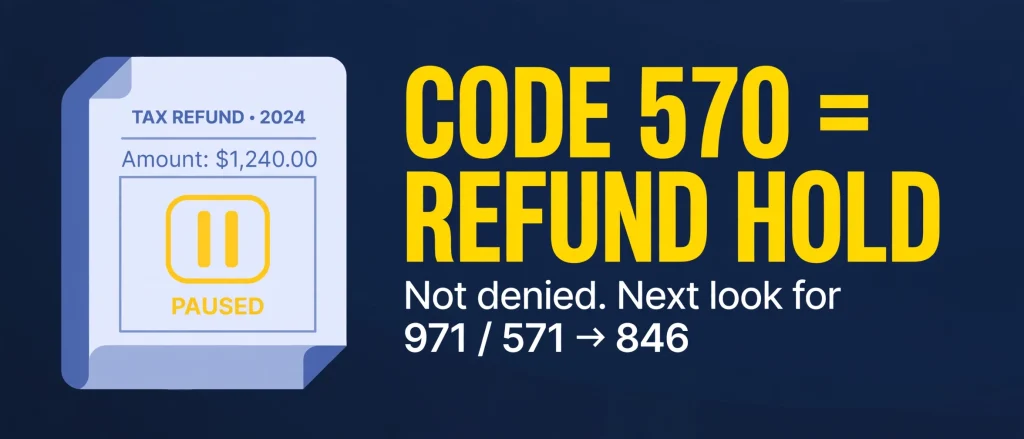
Direct answer: IRS Code 570 means the IRS has placed a temporary hold on your refund while it completes an additional account action. It does not mean your refund is denied or that you are being audited. Most holds clear in 2 to 8 weeks, followed by Code 571 and then Code 846.
If you saw 570 on your IRS transcript codes, you are not alone. This guide explains what it means, why it appears, how long it lasts, and what to do.
What Is IRS Code 570?
On an IRS account transcript, Code 570 is listed as “Additional Account Action Pending.” In plain English, the IRS has paused movement on your account — usually your refund — until it finishes one more step.
Think of it as a yellow light, not a red light. The IRS has your return, but something needs a second look before money is released.
Key facts:
- It is a hold, not a denial. Your refund has not been rejected.
- It is not an audit by itself. A formal audit uses different codes and notices. Code 570 alone does not mean you are under audit.
- The $0.00 on the 570 line is not your refund. It is the amount tied to that transaction, which is often zero.
- The date next to 570 is not a refund date. It is a processing date. If it passes with no change, that alone does not mean something went wrong.
You will see 570 on your Account Transcript in your IRS Online Account or from IRS.gov. “Where’s My Refund?” shows only general stages — your transcript gives the detail.
Why Does Code 570 Appear?
Code 570 is generic — it covers many kinds of “additional action.” The most frequent triggers are:
1. Income or withholding mismatch. If wages, withholding, or 1099 income on your return does not match what employers or banks reported, the system flags the return for manual review. A missing 1099-INT, a corrected W-2, or a typo can trigger this. Check your IRS Code 806 withholding credit line — if withholding does not match your W-2s, that is a common starting point.
2. Credits that need extra verification. Credits such as the Earned Income Tax Credit, Additional Child Tax Credit, and education credits often trigger checks. The IRS verifies eligibility, dependent information, and prior-year patterns before releasing the refund, especially when a credit changed sharply from last year.
3. Identity verification or fraud screening. Automated filters catch identity theft and refund fraud. A new address, new bank account, large income change, or new filing pattern can cause a hold even when everything is legitimate.
4. Math errors or missing forms. A missing schedule, an unsigned return, or a form that does not add up can pause processing. The IRS may correct a simple math error itself or hold the account until it confirms the figure.
5. Prior balance, offset, or pending item. If you owe back taxes, child support, or federal student loans subject to offset, the IRS may hold the refund while it checks. A pending amended return or injured spouse claim can also trigger 570.
6. New deductions or reporting. New reporting — for example, digital asset reporting and deductions for tips or overtime — has increased reviews when claimed amounts do not match third-party reports.
Gap competitors miss: Most guides list “review” and stop. The practical difference is *which* review you are in. A simple income-matching check usually clears faster than an identity or credit-eligibility review. Your next codes and any notice you receive tell you which track you are on. Do not guess from 570 alone — read the sequence below.
Code 570 Sequence Decision Tree
One code never tells the full story. Check your transcript weekly and match your pattern:
570 alone → Hold is active. Do nothing yet. Watch for a notice and for new codes. Check your IRS Online Account for letters.
570 → 571 → Good sign. Code 571 means the 570 hold has been reversed or resolved. Your refund can now move forward. Next, look for Code 846.
570 → IRS Code 971: Notice Issued → Notice issued. The IRS sent a letter. Read it carefully — it will tell you whether to wait, verify identity, or send documents. The notice number (for example, CP05, 5071C, or 12C) matters more than the 971 code itself.
570 stays, no 971 for 3–4 weeks → Still in internal review. Keep monitoring. If nothing changes after 60 days and no notice arrives, consider calling.
571 → 846 → Refund issued. Code 846 shows the date and amount released. See our guide to IRS Code 846 refund issued.
570 + IRS Code 810: Refund Freeze together → Two separate blocks. You have both a processing hold and a stronger refund freeze. Each must clear separately. Do not assume the refund can issue until both are released.
Other codes to watch: Code 290 means an adjustment was made. Code 898 means part of your refund was offset to a debt. Code 841 means a refund was canceled or returned, often for a bad bank account.
IRS Code 570 vs Code 810
Both codes delay a refund, but they are not the same:
| Feature | Code 570 | Code 810 |
|---|---|---|
| Plain meaning | Additional account action pending — general hold | Refund freeze — stronger freeze on refund movement |
| Severity | Moderate — routine hold | Higher — freeze until a specific issue clears |
| Common cause | Income mismatch, credit check, routine review | Identity, fraud screening, or examination freeze |
| Release code | 571 (or 572 if 570 was in error) | 811 (refund freeze released) |
| Typical timeline | 2–8 weeks if no action needed | Weeks to months; often waits for notice + response |
Bottom line: 570 means “pause while we check.” 810 means “freeze until this specific issue is cleared.” If you have 810, do not assume it will clear on the same timeline as a simple 570 hold.
How Long Does Code 570 Last?
There is no single guaranteed timeline. Use this table as a planning range, not a promise:
| Situation | Typical range |
|---|---|
| Simple internal review, no notice | 2–4 weeks → 571 → 846 |
| Review with a notice (971) that says wait | 4–8 weeks |
| Review with a notice that asks for documents | 6–12 weeks after you respond |
| Complex credit, identity, or multi-year issue | 60–120 days or longer |
| 570 + 810 together | 60–180 days in some cases; each must clear separately |
Transcripts update in cycles, usually overnight Tuesday through Saturday. Check once or twice a week — checking hourly will not speed it up.
What To Do: Step-by-Step Checklist
Follow this checklist in order. Do not skip ahead to calling before you have checked for a notice.
- Download your full Account and Return Transcripts. Confirm the tax year, the 570 date, and every code around it. Save a copy to compare next week.
- Check your IRS Online Account for notices. Many notices appear online before the mailed letter. Look for CP05, 12C, 5071C, or 4883C. If you see Code 971, a notice exists — find it.
- Check your tax refund status for the high-level stage. If Where’s My Refund says “being processed” and your transcript shows 570, that matches: the IRS is still working on it.
- Do not file an amended return unless asked. An amendment while a hold is active can create a second return in the system and lengthen the review. Only amend if a notice tells you to or a tax professional advises it.
- Gather documents now. Have W-2s, 1099s, credit proof, and a copy of the return as filed.
- Watch your mail for 2–3 weeks. A missed notice is a common reason a simple hold becomes a long delay.
- Track changes weekly. Note: Did 971 appear? Did 571 appear? Did 846 appear? A simple log helps if you later need to call or contact the Taxpayer Advocate.
- Respond promptly and exactly if a notice asks for something. Send only what it requests, to the address or fax it lists, by its deadline. Keep copies and proof of mailing.
When To Wait vs When To Call
Wait when:
- It has been less than 21 days since you e-filed (or 6 weeks since paper filing) and no notice has arrived.
- You see 570 alone with no 971, and it has been less than 45–60 days.
- A notice tells you to wait 60 days and take no action.
- Your transcript “as of” date is still in the future.
Call or seek help when:
- It has been more than 60 days since 570 appeared, no 971 has appeared, and no 571 or 846 has posted.
- You received a notice with a deadline you cannot meet, or you do not understand what it asks.
- You need the refund for financial hardship — imminent eviction, utility shutoff, or medical need. Contact the Taxpayer Advocate Service and explain the hardship. TAS prioritizes genuine hardship cases.
- You suspect identity theft, or Where’s My Refund and your transcript contradict each other for weeks.
When you call, have ready: Social Security number, filing status, tax year, transcript codes and dates, and notice number if you have one. Note the agent ID, date, and what they told you.
Will Code 570 Affect Your Refund Amount?
Code 570 alone does not change your refund — it only pauses release. But the *reason* for the hold can:
- If the IRS corrects an error or disallows part of a credit (often Code 290), your refund may be smaller.
- If part is offset to a debt (Code 898), you will receive less and get an offset notice.
- If the hold clears with 571 and no adjustment, your refund should be the amount on your return, released as 846.
How To Avoid Code 570 Next Year
You cannot guarantee you will never see 570 again, but you can lower the odds:
- File accurately. Double-check names, Social Security numbers, and every income figure against W-2s and 1099s.
- Report all income, even small amounts. A missing $50 interest form can trigger a mismatch review.
- Keep credit documentation for EITC, ACTC, or education credits organized.
- File early and electronically with direct deposit — it processes faster and has fewer errors than paper filing.
Related Guides
- IRS Code 971: Notice Issued — Meaning, Timeline & Next Steps
- IRS Code 810: Refund Freeze vs Code 570 & How It Clears
- IRS Code 846: Refund Issued — Meaning & Timeline
- IRS Transcript Codes: Complete Guide
IRS Code 570 FAQ
Does Code 570 mean I am being audited?
No, not by itself. Code 570 means additional account action is pending — a hold for review. A formal audit uses different procedures and notices. Most 570 holds are routine processing reviews, not audits.
How long does Code 570 last before my refund is released?
Most simple holds resolve in 2 to 8 weeks. If a notice asks for documents, add response + processing time, often another 6 to 12 weeks. Complex cases can take 60 to 120 days.
Will I get a letter if I have Code 570?
Not always. Many holds clear with no letter. If Code 971 appears, a notice was issued — check your IRS Online Account and mail. If no 971 appears, the IRS may be completing an internal review with no notice needed.
What is the difference between Code 570 and Code 571?
Code 570 places the hold. Code 571 reverses it. When you see 571 after 570, the hold has lifted and your refund can move toward 846. Code 572 is similar but means the 570 was processed in error and corrected.
Should I call the IRS as soon as I see Code 570?
Usually no. Calling early rarely gives new information. Wait for a notice, or at least 45 to 60 days if none appears. Call sooner for hardship, a deadline, or suspected identity theft.
*Disclaimer: This article is general information only and is not tax advice. Tax situations vary. For advice about your specific return, consult a qualified tax professional or contact the IRS or the Taxpayer Advocate Service. Verify deadlines and instructions on any IRS notice you receive, as the notice controls your next step.*
Sources: IRS — Get Transcript · Taxpayer Advocate Service