IRS Cycle Code: How to Read Your Transcript Cycle Code (2026)
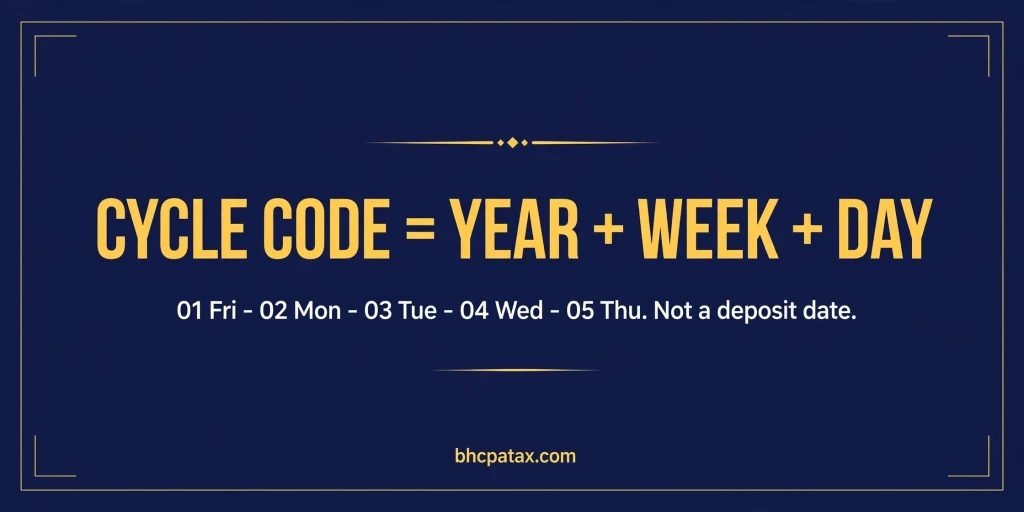
Direct answer: The cycle code is the 8-digit number in the CYCLE column next to Code 150 on your transcript. Format: YYYYWWDD — the first 4 digits are the processing year, the next 2 are the processing week of the year, and the last 2 are the posting day: 01 = Friday, 02 = Monday, 03 = Tuesday, 04 = Wednesday, 05 = Thursday. It tells you when your account posts — not when your refund arrives.
The cycle code is one of the most searched and most misunderstood parts of an IRS transcript. Some guides get it right; others spread a myth that costs readers weeks of false hope. This guide shows you where to find your cycle code, how to decode it with a worked example, the full 01–05 posting-day chart, how it differs from the processing date and transaction date, when your transcript updates, and which myths to ignore.
What the Cycle Code Is and Where to Find It
Your IRS account transcript is a table of transaction codes, dates, and amounts. Near the top, next to Code 150 (Tax Return Filed), there is a column labeled CYCLE. The 8-digit number in that column is your cycle code.
For example, a transcript might show:
| Code | Explanation | Cycle | Date | Amount |
|---|---|---|---|---|
| 150 | Tax Return Filed | 20260405 | 03-10-2026 | $1,850.00 |
In this example, the cycle code is 20260405. That is the number this guide teaches you to read.
Two things to know up front:
- The cycle code is a posting/batch marker. It identifies the processing cycle (week + day) in which your return posted to the master file.
- It is not a deposit date, a refund date, or an approval status. Anyone telling you otherwise is selling a myth — see the myths section below.
How to Decode the Cycle Code: YYYYWWDD
The IRS defines the cycle date as an 8-digit number: year + week + day (IRS IRM 3.30.123). Split it into three parts:
| Digits | Part | Meaning |
|---|---|---|
| 1–4 | YYYY | Processing year (the IRS processing year, which usually matches the calendar year) |
| 5–6 | WW | Processing week of the year (01–53) |
| 7–8 | DD | Posting day within that week (01–05) |
Worked Example: 20260405
Split 20260405 into three parts:
- 2026 — processing year 2026.
- 04 — processing week 4 of the year (roughly late January).
- 05 — posting day 05, which is Thursday.
So cycle 20260405 means: the return posted in processing week 4 of 2026, on the Thursday posting day.
Another Example: 20261002
- 2026 — year 2026.
- 10 — processing week 10 (roughly early March).
- 02 — posting day 02, which is Monday.
One more note: the processing week is the IRS processing week, not necessarily the calendar week you would count on your wall calendar. The year and week tell you which batch your return posted in; the day tells you which posting day within that batch.
The Posting-Day Chart: 01–05 (Full Table)
The last two digits are the part that matters most for “when does my transcript update?” Here is the complete chart, confirmed against IRS IRM 3.30.123:
| Day Code | Posting Day | Processing Type |
|---|---|---|
| 01 | Friday | Daily accounts |
| 02 | Monday | Daily accounts |
| 03 | Tuesday | Daily accounts |
| 04 | Wednesday | Daily accounts |
| 05 | Thursday | Generally weekly processing |
What this means in practice:
- Codes ending 01–04 are daily accounts. Transcripts for these accounts can update on their posting day each week — Friday, Monday, Tuesday, or Wednesday respectively.
- Codes ending 05 are generally weekly. These accounts generally update once a week, on Thursday. (The word “generally” matters: weekly processing is the norm for 05 accounts, but individual transcripts can vary.)
How to Use the Chart
Find your cycle code’s last two digits, then match them to the day above. That day is the weekday your transcript is most likely to update. If your code ends in 02, check your transcript on Mondays. If it ends in 05, check on Thursdays.
This is also why two people who filed on the same day can see updates on different days: their cycle codes put them on different posting days.
Cycle Code vs. Processing Date vs. Transaction Date
Three dates on your transcript look similar and mean different things. Mixing them up is the second-biggest source of confusion after the per-digit myth.
| Field | What it is | Example |
|---|---|---|
| Cycle code | The processing cycle (year + week + day) your return posted in | 20260405 |
| Processing date | A target-week marker the IRS assigns; roughly, the week by which the IRS expects to process the transaction | 03-10-2026 |
| Transaction date | The date a specific transaction code posted to your account | Varies by code |
Rules of thumb:
- The cycle code tells you the batch and posting day. It does not promise a deposit.
- The processing date is a planning marker, not a payday. If nothing happens by the processing date, it usually means the transaction is still in the queue — not that it failed.
- The transaction date next to each code (570, 971, 846, etc.) is when that specific code posted. Read each code’s own date rather than assuming all codes share the cycle date.
When Your Transcript Updates (By Day Code)
Your transcript does not update every day. It updates on your posting day, driven by your cycle code’s last two digits:
- 01 (Friday): Updates most likely on Fridays.
- 02 (Monday): Updates most likely on Mondays.
- 03 (Tuesday): Updates most likely on Tuesdays.
- 04 (Wednesday): Updates most likely on Wednesdays.
- 05 (Thursday): Updates most likely on Thursdays (weekly).
Practical advice:
- Check your transcript on your posting day, not every day. Checking daily creates false anxiety.
- Updates often appear overnight. If your posting day is Thursday, check Friday morning.
- A missing update on your posting day does not mean a problem. Holds (570, 810), notices (971), and reviews can pause updates without changing your cycle code.
What Happens When Your Cycle Code Changes?
Sometimes a transcript shows a new cycle code after an update. This usually means a new transaction posted in a new cycle — for example, after an amended return (977) or an adjustment (290). A changed cycle code is not by itself a problem. Read the new codes that came with it.
Does the Cycle Code Predict Your Deposit?
No — and this is the most important correction in this guide.
The cycle code does not tell you when your refund will arrive. The only code that means “refund issued” is 846 (Refund Issued). Your deposit timing depends on:
- Code 846 posting. Until 846 appears, no refund has been issued, regardless of your cycle code.
- Your bank. After 846, direct deposits typically arrive within 1–5 business days, depending on your bank.
- PATH Act holds. If you claimed the Earned Income Credit (768) or the Additional Child Tax Credit, the IRS cannot issue your refund before mid-February by law, no matter what your cycle code says.
So the correct way to use the cycle code is: it tells you when to check for updates (your posting day). Code 846 tells you when the refund was issued. Your bank tells you when it lands.
Myths to Ignore
Myth 1: “Each digit is a status” — WRONG
At least two competing pages decode the cycle code digit-by-digit as processing / review / approval status — for example, claiming the first digit means “processing status” and that certain digits mean “still processing.” That is wrong. The 8 digits are year + week + day only. No digit encodes approval, review, or denial status. If a guide tells you your first digit means your return is “stuck,” ignore it.
Myth 2: “The cycle code is your deposit date” — WRONG
The cycle code is a posting/batch marker, not a payday. A cycle ending in 05 does not mean your refund arrives Thursday. Only Code 846 means a refund was issued.
Myth 3: “A weekly (05) code means something is wrong” — WRONG
Code 05 simply means generally-weekly processing. It is a normal processing pattern, not a flag, a hold, or a delay signal.
Myth 4: “If your cycle code never changes, nothing is happening” — WRONG
Your cycle code stays the same while your return sits in its original cycle. Progress shows up as new transaction codes (571, 971, 846), not as a changing cycle code.
Worked Example: Reading a Full Transcript With the Cycle Code
Put it all together with a sample transcript:
| Code | Explanation | Cycle | Date | Amount |
|---|---|---|---|---|
| 150 | Tax Return Filed | 20260803 | 03-02-2026 | $2,100.00 |
| 806 | Federal Tax Withheld | — | 04-15-2026 | -$2,600.00 |
| 570 | Additional Account Action Pending | — | 03-20-2026 | $0.00 |
| 971 | Notice Issued | — | 04-01-2026 | $0.00 |
| 571 | Additional Account Action Resolved | — | 04-28-2026 | $0.00 |
| 846 | Refund Issued | — | 05-02-2026 | -$500.00 |
Read it in order:
- Cycle 20260803 — posted in processing week 8 of 2026, posting day 03 (Tuesday). Check for updates on Tuesdays.
- 150 + 806 — return filed, $2,600 withheld against $2,100 tax, so a $500 overpayment exists.
- 570 → 971 → 571 — a hold, a notice, then the hold released.
- 846 — refund of $500 issued. Only this line means the refund went out.
Notice what the cycle code did and did not do: it told you the posting batch and the Tuesday update day. It did not tell you the refund amount ($500 came from 150 vs. 806), the hold (570), or the issue date (846’s own date). That division of labor is the whole point.
- Cycle code + 570 hold: A hold pauses processing but does not change your cycle code. Watch for 571 (hold released) or 971 (notice).
- Cycle code + 898 offset: An offset can reduce your refund after 846. The cycle code does not predict offsets.
- Cycle code + 776 interest: If your refund was delayed past the roughly 45-day interest window, interest under Code 776 may post after 846.
- Cycle code + 766/768 credits: Credits post as their own transaction codes. The cycle code tells you when to check for them, not when they pay.
Related Guides
- IRS Code 150: Tax Return Filed — Meaning, Amount & Next
- IRS Code 846: Refund Issued — Meaning, Timeline & What Comes Next
- IRS Code 570: Refund Hold Meaning, Timeline & What To Do
- IRS Code 977: Amended Return Filed — Meaning & Timeline
Frequently Asked Questions
What is my IRS cycle code?
The 8-digit number in the CYCLE column next to Code 150 on your transcript. Format: YYYYWWDD — year, processing week, posting day.
What do the last two digits of the cycle code mean?
The posting day: 01 = Friday, 02 = Monday, 03 = Tuesday, 04 = Wednesday, 05 = Thursday. Codes ending 01–04 are daily accounts; 05 is generally weekly (Thursday) processing.
Does my cycle code tell me when my refund arrives?
No. Only Code 846 (Refund Issued) means a refund was issued. The cycle code tells you which day your transcript is most likely to update.
My cycle code ends in 05. Is something wrong?
No. Code 05 means generally-weekly processing — a normal pattern, not a hold or a problem.
Why did my cycle code change?
Usually because a new transaction (an amended return, an adjustment, a new credit) posted in a new cycle. Read the new codes that came with it; the change itself is not a problem.
Do the digits of the cycle code show processing or approval status?
No. That is a myth. The 8 digits are year + week + day only. No digit encodes approval, review, or denial status.
*Disclaimer: This article is general information only and is not tax advice. Cycle-code rules depend on your specific facts. For advice about your situation, consult a qualified tax professional or contact the IRS.*
Sources: IRS IRM 3.30.123 — IMF Cycle Date · IRS Transcript Codes: Complete List and Meanings