IRS Code 420: Examination Indicator — Audit or Just Review?
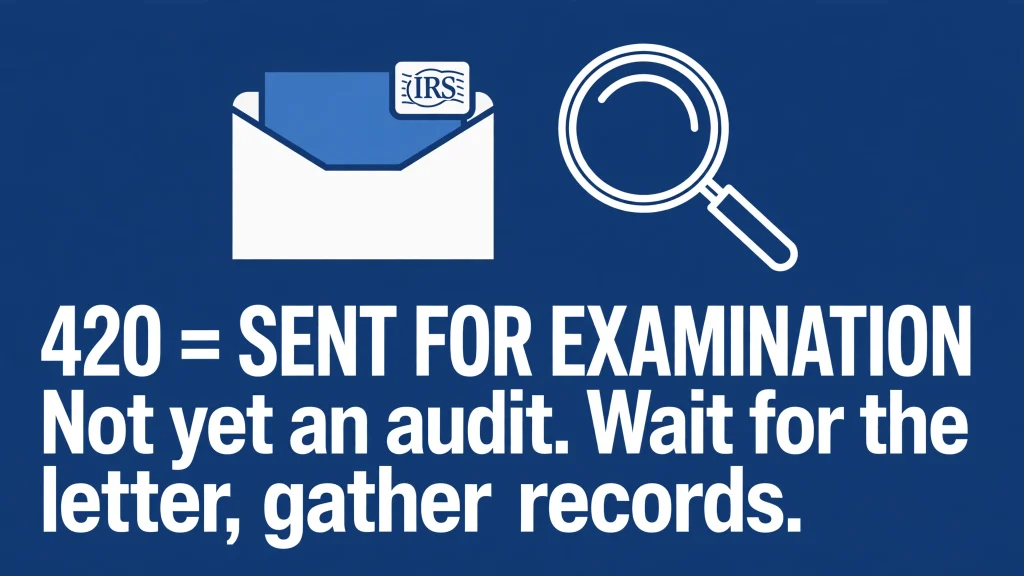
Direct answer: IRS Code 420 means your tax return was flagged and sent for examination. It does not automatically mean you face a full audit. Examination can be a document check, a correspondence review, or a formal audit — and the notice you receive will tell you which one applies to your return.
If you found 420 on your IRS transcript codes page, do not panic. This guide explains what Code 420 means, how it differs from Codes 424 and 421, which notice to expect, what to gather, what not to send, and how long each path usually takes.
What Is IRS Code 420?
On an IRS account transcript, Code 420 is described as an examination indicator. In plain English, it means the IRS has pulled your return out of normal processing and routed it to its examination function for a closer look.
Think of it as a referral, not a verdict. The IRS has not decided you did anything wrong. It has decided your return needs a human review before it can finish processing.
Key facts:
- Code 420 is a referral, not an audit notice. The audit itself, if one happens, is communicated by a separate letter with instructions, deadlines, and appeal rights.
- It often freezes refund movement. While examination is pending, your refund may be held. If you also see an IRS Code 810: Refund Freeze, that freeze is a separate block that must clear on its own.
- The date next to 420 is not an audit date. It is the date the referral was posted or the IRS processing date. It does not tell you when an examiner will contact you.
- The $0.00 on the 420 line is not a balance. Like most indicator codes, the amount on the 420 line is usually zero. Any tax change, if there is one, appears later as a separate code such as IRS Code 290: Additional Tax Assessed.
- Code 420 can appear with or without a hold. You may see it alone, with an IRS Code 570: Refund Hold, or with an IRS Code 971: Notice Issued. The combination tells you more than 420 alone.
You will see 420 on your Account Transcript in your IRS Online Account or from IRS.gov. “Where’s My Refund?” shows only general stages — check your tax refund status for the high-level stage, then use your transcript for the detail.
Why Does Code 420 Appear?
The IRS does not publish a single public reason for every 420 referral, because the code covers several screening paths. The most frequent triggers are:
1. Computer scoring flagged an item. The IRS scores returns for unusual patterns — for example, deductions far above the norm for your income, a large swing in credits, or income that does not match third-party reports. A high score can trigger a referral even when the return is correct.
2. Income or withholding mismatch. If wages, withholding, or 1099 income on your return does not match what employers, banks, or brokers reported, the return may be referred for verification. Check your IRS Code 806 withholding credit line — if withholding does not match your W-2s, that is a common starting point.
3. Credit eligibility questions. Credits such as the Earned Income Tax Credit, Additional Child Tax Credit, and education credits are examined more often, especially when the credit changed sharply from last year or when dependent information is unclear.
5. Random or targeted selection. A small share of returns are selected for examination even when nothing looks wrong. Selection alone is not an accusation.
Gap competitors miss: Most pages list Code 420 in a table as “examination” and stop. They do not explain the sequence — 420, then 424, then 421 — or give you an action checklist. The practical question is not “what does 420 mean?” but “which examination track am I in, and what do I do next?” The next codes and your notice answer that.
IRS Code 420 vs 424 vs 421 — The Sequence That Matters
Code 420 is only the first step. Watch for these follow-up codes:
| Code | Plain meaning | What it tells you |
|---|---|---|
| 420 | Examination indicator — return sent for examination | Your return was referred. No audit letter yet. Wait for the notice. |
| 424 | Examination request — examiner assigned or case opened | The case moved from referral to an active examination workstream. |
| 421 | Examination closed — case finished | The examination is done. Look for the outcome: no change, adjustment, or a notice explaining the result. |
| 420 + 810 | Examination referral + refund freeze | Two separate blocks. The freeze must clear (811) even if examination closes. |
| 420 + 971 | Examination referral + notice issued | A letter exists. Read the notice number — it controls your deadline. |
Bottom line: 420 means “sent.” 424 means “being worked.” 421 means “closed.” Do not assume you are under a full audit just because you see 420, and do not assume the case is over until you see 421 plus a closing notice or a Code 846 refund.
If you see 420 and then nothing changes for weeks, that is common. Examination queues move slowly, especially in peak season. Keep monitoring your transcript weekly and check your IRS Online Account for letters.
Which Notice Comes With Code 420?
Code 420 by itself does not tell you the examination type. The notice does. After 420 appears, watch for an IRS Code 971: Notice Issued entry, which means a letter was generated. Then find the actual letter in your IRS Online Account or your mail.
Common notices tied to examination:
| Notice | What it usually means | What to do |
|---|---|---|
| CP75 / CP75A | EITC or Child Tax Credit documentation requested | Send the exact proof listed — residency, relationship, and support documents for the credit claimed. |
| CP2000 | Proposed adjustment — income reported to the IRS does not match your return | Respond by the deadline: agree, partially agree, or disagree with documentation. Do not ignore it. |
| Letter 2205 / audit letter | Formal examination opened | Follow the letter’s instructions for documents, meeting type, and deadline. You have appeal rights. |
If no letter arrives within 2–3 weeks of 420: Wait 14 days for mail, check your IRS Online Account, and verify your address on file. If 30 days pass with no letter and no new codes, consider calling the IRS to ask for the examination status and the notice number tied to any 971 entry.
What if your notice number is not listed here? Do not guess. Search it on IRS.gov or call the number printed on the notice itself — not a number from a random website. The notice controls your next step.
What To Gather — And What NOT To Send
Do not rush to send papers the moment you see 420. Send the right papers, to the right place, at the right time.
Gather now (keep organized, do not send yet unless asked)
- A copy of the return as filed, including every schedule and form.
- W-2s, 1099s (including 1099-NEC, 1099-INT, 1099-K), and broker statements.
- Proof for any credits claimed — for EITC or Child Tax Credit, keep residency, relationship, and support records.
- Proof for any large deductions — receipts, mileage logs, business records, or charitable donation letters, depending on what you claimed.
- Prior IRS notices for the same tax year, plus your response dates.
What NOT to send
- Do not send extra documents the notice did not ask for. Extra pages can slow processing and create new questions.
- Do not file an amended return unless told to. An unnecessary amendment while examination is pending can create a second processing track and delay your refund. Only amend if a notice tells you to or a tax professional advises it.
- Do not send originals. Send copies only, and keep a complete copy of everything you send, with proof of mailing.
- Do not use a link from an email or text. The IRS does not start an audit by email or text with a link. Use only the address, fax, or phone number on the official letter or on IRS.gov.
- Do not ignore the deadline. If you cannot meet it, call the number on the notice before it passes and ask for more time. A missed deadline can lead to a proposed adjustment based only on the IRS’s figures.
If the examination is a correspondence review, you will usually respond by mail or fax. If it is a formal audit, the letter will explain whether it is an office audit, a field audit, or a correspondence audit, and what to expect. In every case, you have the right to representation and to appeal if you disagree.
How Long Does Code 420 Last? Timeline + Link to 810
There is no single guaranteed timeline for 420. Use this table as a planning range:
| Situation | Typical range |
|---|---|
| Document check (CP75, 12C) — you respond completely | 6–12 weeks after the IRS receives your complete response |
| CP2000 proposed adjustment — you agree | Often 4–8 weeks after your signed response |
| CP2000 — you disagree with documentation | 60–120 days is common |
| Formal examination (office or field) | Several months; complex cases can take 6–12 months |
| 420 + 810 together | Examination must close AND the freeze must clear (811) before 846 |
| No notice, no new codes after 60 days | Call or seek help — do not wait indefinitely |
How 420 interacts with a freeze: If you also have an IRS Code 810: Refund Freeze, your refund cannot issue until both the examination closes (421) and the freeze releases (811). Clearing one does not clear the other. After both clear, look for IRS Code 846: Refund Issued to confirm money was sent.
How 420 interacts with a hold: If you also have an IRS Code 570: Refund Hold, that hold must reverse with an IRS Code 571: Hold Released before your refund can move. Think of it as three gates: 570 → 571, 810 → 811, and 420 → 421. All gates that apply to you must open before 846 posts.
Transcripts update in cycles, usually overnight Tuesday through Saturday. Check once or twice a week. Checking hourly will not speed up an examination queue.
When To Wait vs When To Call
Wait when: It has been less than 30 days since 420 appeared, a notice tells you to wait 60 days, or you just sent a complete response.
Call or seek help when: It has been more than 60 days with no notice and no 424/421, you cannot meet a deadline, you responded 45+ days ago with no change, you face hardship, or you suspect a scam. For hardship, contact the Taxpayer Advocate Service.
When you call, have ready: Social Security number, filing status, tax year, transcript codes and dates, and notice number if you have one. Note the agent ID, date, and what they told you.
Appeal Rights and Taxpayer Advocate Help
An examination is not the final word. If you disagree, read the closing notice, respond by the deadline, and request Independent Office of Appeals review if eligible. For hardship or long delay, contact the Taxpayer Advocate Service. Do not ignore a closing notice — disagreement is handled through response and appeal, not silence.
Related Guides
- IRS Code 570: Refund Hold Meaning, Timeline & What To Do
- IRS Code 571: Hold Released — Meaning & What Comes Next
- IRS Code 290: Additional Tax Assessed — $0 vs Amount Owed
- IRS Transcript Codes: Complete Guide
IRS Code 420 FAQ
Does Code 420 mean I am being audited?
Not necessarily. Code 420 means your return was sent for examination, which can be a document check, a correspondence review, or a formal audit. The notice tells you which type applies.
What is the difference between Code 420, 424, and 421?
420 means sent for examination, 424 means opened or assigned, 421 means closed. Watch the sequence — 421 plus a closing notice tells you the outcome.
How long does Code 420 last?
It varies. A document check often resolves 6–12 weeks after a complete response. A CP2000 dispute can take 60–120 days. A formal examination can take months. If 420 is paired with an 810 freeze, both must clear first.
Will I get a letter if I have Code 420?
In most cases, yes. Code 971 often appears with 420, meaning a notice was issued. Check your IRS Online Account and mail. If no notice appears after 30 days, call the IRS to ask for the examination status and notice number.
Should I call the IRS as soon as I see Code 420?
Usually no. First check for a notice and read it. If it asks for documents, gather and send exactly what it lists. Call if no notice appears after 30–60 days, if you cannot meet a deadline, or if you face hardship. Calling in the first few days rarely gives new information.
Can I still get my refund if I have Code 420?
Possibly, but not until the examination closes and any hold or freeze clears. If you have 570, you need 571. If you have 810, you need 811. After those clear and 421 posts, look for Code 846 to confirm your refund was issued.
*Disclaimer: This article is general information only and is not tax advice. Tax situations vary. For advice about your specific return, consult a qualified tax professional or contact the IRS or the Taxpayer Advocate Service. Always follow the instructions and deadline on your official IRS notice.*
Sources: IRS — Get Transcript · Taxpayer Advocate Service