IRS Code 150 With an Amount: How to Interpret It
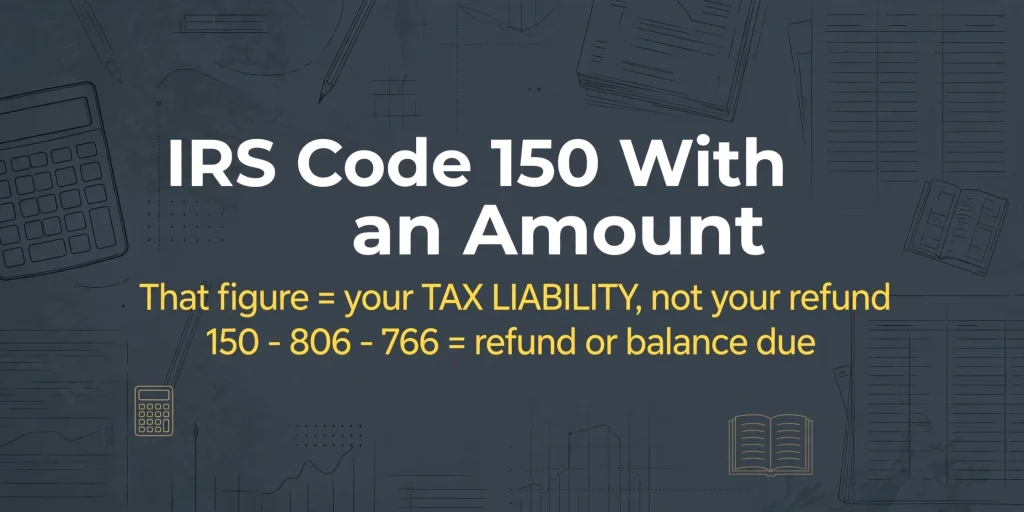
Direct answer: The dollar amount next to IRS Code 150 is your computed tax liability for the year — the ‘bill’ side of your transcript ledger, not your refund. The IRS subtracts your credits (Code 806 withholding, Code 766/768 refundable credits) from that amount: if credits exceed the liability, you get a refund (Code 846); if not, you owe the difference.
Code 150 — “Tax Return Filed” — is usually the first substantive line on your IRS account transcript, and the dollar figure beside it startles a lot of filers. It looks like a bill. It is not a bill, and it is definitely not your refund. It is the starting number in the IRS’s ledger math: your total tax for the year, computed from the return you filed (or as corrected by the IRS during processing), before any payments or credits are applied. This guide explains exactly what that amount represents, how the credits below it transform it into a refund or a balance due, and what to do when the number doesn’t match your return — all with worked numeric examples.
For the full catalog of transcript entries this code sits alongside, see our pillar reference, IRS Transcript Codes: Complete List and Meanings.
What the Code 150 Amount Actually Is
When the IRS processes your return, it posts Code 150 with the tax liability computed from that return — your total tax for the year *before* subtracting withholding, payments, or refundable credits. Think of it as the raw tax figure: income run through the brackets, minus deductions, plus any additional taxes, exactly as your return reported it.
Two important nuances:
- “As filed or as corrected.” The amount reflects your return *as the IRS processed it*. If the IRS corrected a math error during processing, the 150 amount is the corrected figure, not necessarily what your software or preparer showed. (A separate adjustment code, usually 290 or 291, often documents the correction.)
- It is a charge, not a demand. On the transcript, Code 150 posts as a *positive* amount — a debit against your account. That is normal bookkeeping, not a bill. The credits that follow (withholding, refundable credits) post as *negative* amounts and subtract from it. Don’t panic at the positive number; read it together with the credit lines below it.
For the dedicated guide on this code alone, see IRS Code 150.
The Transcript Math: 150 Minus Credits = Your Outcome
Your account transcript is a ledger, and Code 150 is the opening balance. The formula the IRS applies is:
Code 150 (tax liability) − Code 806 (withholding) − Code 766/768 (refundable credits) = account balance
- A negative result means the credits exceeded your tax — an overpayment that becomes your refund (Code 846).
- A positive result means your tax exceeded your credits — a balance you owe.
- Zero means the credits exactly covered your tax — no refund, no balance due.
The dollar figure next to Code 150 is only meaningful in this equation. By itself it answers one question: “how much tax did the IRS compute for me this year?” Everything else — refund or bill — comes from the credits.
Worked Examples: Reading the 150 Amount in Context
Here are three scenarios showing how the same kind of 150 line produces very different outcomes:
| Scenario | Code 150 (tax) | Code 806 (withholding) | Code 766/768 (credits) | Result |
|---|---|---|---|---|
| A. Refund | $4,200 | −$3,800 | −$1,700 (766, ACTC) | −$1,300 → refund (Code 846 issues $1,300) |
| B. Balance due | $6,100 | −$4,900 | none | +$1,200 → you owe $1,200 |
| C. $0 liability | $0 | −$2,400 | −$2,000 (768, EIC) | −$4,400 → refund of the full credit amount |
Reading each one:
- Scenario A is the classic W-2 filer with a refundable credit: $4,200 of tax, but $5,500 of credits against it. The −$1,300 overpayment is the gross refund before any holds or offsets.
- Scenario B is the under-withheld filer: withholding covered most of the tax, but $1,200 remains — a balance due, with no 846 on the horizon.
- Scenario C surprises people: Code 150 shows $0, yet the filer gets a $4,400 refund. That is correct — refundable credits (like the EIC in Code 768) can pay out even when the computed tax is zero. A $0 next to 150 never means “no refund.”
This exact math is also why IRS Codes 806 and 766: What Do They Mean Together? and IRS Codes 150, 806 and 570: How to Read Them Together exist — the credit lines only make sense read against the 150 line.
When the 150 Amount Doesn’t Match Your Return
If the dollar figure next to Code 150 differs from the total tax on the return you filed, the IRS changed something during processing. Work through this:
| Situation | What it usually means | What to do |
|---|---|---|
| 150 is higher than your return’s tax | The IRS corrected a math error or disallowed something (deduction, credit) — often paired with Code 290 (additional tax assessed) | Find the 290/291 line and any Code 971 notice; the notice explains the change; see IRS Code 290 |
| 150 is lower than your return’s tax | The IRS reduced your tax (correction in your favor), often with Code 291 | Confirm against your return; the difference may increase your refund |
| 150 shows $0 but you expected tax | Return processed with no computed liability — or the return hasn’t fully posted | Compare with your filed return; if the return clearly shows tax, wait for processing to complete and recheck |
| 150 amount matches, but credits differ | Your withholding (806) or credits (766/768) don’t match your W-2s or return | Match each credit line against your documents — a mismatch can trigger verification holds (570/810); see How to Read an IRS Account Transcript: Step-by-Step Guide |
Never “fix” a mismatched 150 by filing a second original return — that creates a duplicate-filing mess. If you disagree with an IRS correction, the notice that accompanies it explains your appeal and response options.
Does the Code 150 Amount Ever Change?
The 150 line is your *opening* assessment, and later events adjust around it rather than rewriting it:
- IRS adjustments post as new lines. If the IRS increases your tax after processing, you will typically see Code 290 (additional tax assessed); if it reduces your tax, Code 291. Your final liability is 150 ± those adjustments — the original 150 line stays as the historical starting point.
- Amended returns add new activity. Filing Form 1040-X posts Code 977 and eventually its own adjustment lines (the 29X/30X series). The original 150 line remains; the amended figures layer on top.
- This is why you read the whole transcript, not one line. The 150 amount answers “what was my computed tax at filing?” — the *current* balance comes from every line below it. When the numbers don’t reconcile, the adjustment lines (290/291) and any 971 notices are where the explanation lives.
The Code 150 Date and Your Cycle Code
The date next to Code 150 is when the IRS posted your return to the master file — effectively your processing date for that tax year. It is not a refund date and not a payment deadline. The 8-digit cycle code beside the 150 line tells you whether your account updates daily or weekly, which explains why two identical returns can show different transcript rhythms. Our IRS Cycle Code guide decodes it.
And remember the sequence: 150 opens the ledger, the credit lines (806, 766, 768) fill in, holds or notices (570, 810, 971) may intervene, and only Code 846 closes it with a refund. If 846 is the line you’re actually waiting for, read IRS Code 846: Refund Issued — and if it isn’t there yet, No IRS Code 846 on Your Transcript: What It Means diagnoses why. The IRS’s master-file code definitions live in IRS Document 6209, Section 8A, and refund-timing basics are covered in the IRS’s ten things to know about tax refunds.
Related Guides
- IRS Transcript Codes: Complete List and Meanings
- IRS Code 150
- IRS Codes 806 and 766: What Do They Mean Together?
- How to Read an IRS Account Transcript: Step-by-Step Guide
Frequently Asked Questions
Is the amount next to IRS Code 150 what I owe?
Not necessarily. The 150 amount is your computed tax liability *before* credits and payments. What you actually owe (or are owed) is that amount minus your withholding (806) and refundable credits (766/768). A $5,000 figure next to 150 with $6,000 of credits means a $1,000 refund, not a $5,000 bill.
Can Code 150 show $0 and I still get a refund?
Yes. A $0 next to Code 150 means the IRS computed zero tax liability for the year — but refundable credits like the Earned Income Credit (768) or the Additional Child Tax Credit (766) pay out even when tax is zero. The refund comes from the credits, not from the 150 line.
Why is my Code 150 amount different from my tax return?
The IRS corrected something during processing — a math error, a disallowed deduction or credit, or an income mismatch. Look for a companion adjustment code (290 for additional tax, 291 for a reduction) and a Code 971 notice explaining the change. Compare the transcript figures against your filed return line by line before responding.
Does a higher Code 150 amount mean a smaller refund?
Generally, yes — all else equal. The 150 amount is the “bill” side of the ledger, so a larger liability leaves less overpayment after the same credits are subtracted. But your refund depends on the *difference* between 150 and your total credits, not on the 150 figure alone.
Is the date next to Code 150 my refund date?
No. The date next to Code 150 is when the IRS posted your return to the master file — your processing date. Your refund date, if a refund is coming, is the date next to Code 846 (“Refund Issued”), which posts much later in the sequence. See IRS Code 846 With a Future Date: When Will You Get Your Refund? for what that date means.
What if Code 150 is the only code on my transcript?
That means your return was received and posted, but processing isn’t finished — credits, holds, and the refund line post in later cycles. Give it time (most e-filed returns complete within about 21 days), then look for 806, 766/768, and eventually 846. If weeks pass with only 150, check for hold codes (570/810) or a notice (971).
*Disclaimer: This article is for general information only and is not tax advice. Transcript codes reflect IRS processing actions and can change with your specific facts. For questions about your account, consult a qualified tax professional or contact the IRS directly.*