IRS Code 846 With a Future Date: When Will You Get Your Refund?
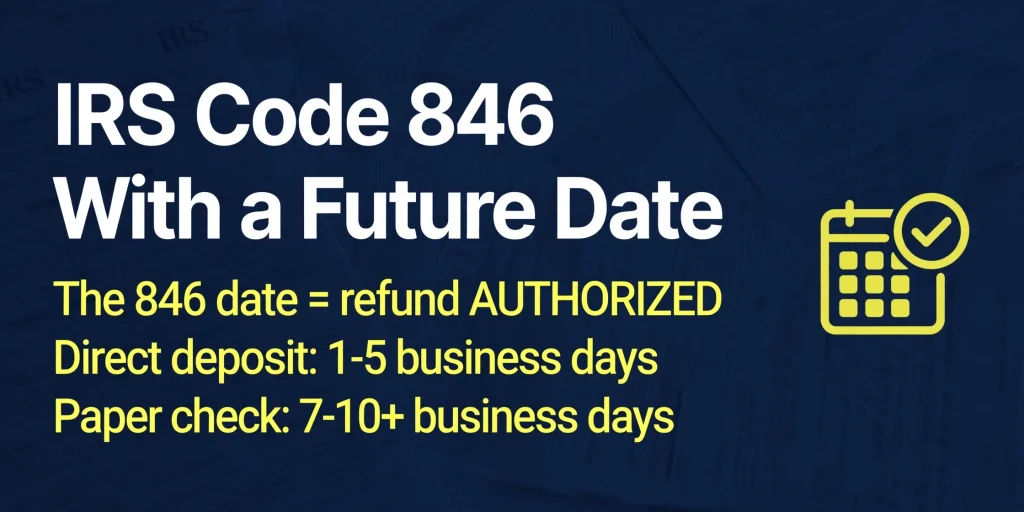
Direct answer: The date next to IRS Code 846 is the date the IRS authorized your refund — not the day money lands in your account. Direct deposit arrives within 1–5 business days after that date; paper checks can take 7–10 business days or more. If ten business days pass with no money, check with your bank first, then the IRS.
Few moments in tax season feel stranger than this one: you check your IRS account transcript, find the long-awaited Code 846 — “Refund Issued” — and the date next to it is in the *future*. Is that a mistake? Does it mean something went wrong? Not at all. The “future date” next to Code 846 is completely normal, and understanding what it actually means will tell you exactly when to expect your money. This guide breaks down the 846 date line by line, the real arrival windows for direct deposit and paper checks, and the step-by-step protocol for what to do if the date comes and goes without your refund.
For the full catalog of transcript entries this code sits alongside, see our pillar reference, IRS Transcript Codes: Complete List and Meanings.
What the Date Next to Code 846 Actually Means
Code 846 is the IRS’s “Refund Issued” line: it confirms the IRS finished processing your return, approved the refund amount shown, and authorized the payment. The date beside it — often called the “Date of Transaction” — is the date the IRS authorized the release of your refund to the U.S. Treasury’s Bureau of the Fiscal Service for delivery.
That is the key distinction: the 846 date is the authorization date, not the arrival date. The IRS stamps its approval, hands the payment to the Treasury, and the Treasury moves the money to you — either as an electronic deposit to your bank or as a paper check through the mail. Those last steps take real time, and their speed depends on your payment method and your bank, not the IRS.
If you want the full deep dive on this code alone, read IRS Code 846: Refund Issued.
Why the 846 Date Looks Like a “Future Date”
Transcripts often update *before* the money moves. When your transcript refreshes and shows Code 846 with a date several days out, it means the IRS has scheduled the release in advance — the payment is queued, not late. The transcript is the IRS’s internal ledger, so it records the authorization the moment it happens; your bank account only changes when the Treasury’s transfer actually lands.
This is also why the 846 date is more reliable than the processing date shown elsewhere on your transcript. The processing date is the IRS’s internal estimate of its next action on your account; the 846 date is a committed release authorization. Confusing the two is one of the most common transcript-reading mistakes — our Tax Refund Status: Check Your Federal and State Refund guide walks through how to read both correctly.
Direct Deposit vs Paper Check: Real Arrival Windows
Once Code 846 posts, your refund travels one of two roads. The IRS publishes no fixed per-payment timeline, so the ranges below reflect widely reported industry and legal-guidance experience — bank processing times are the main variable.
| Method | After the 846 date, expect | Notes |
|---|---|---|
| Direct deposit | Within 1–5 business days | Most deposits land on or within a couple of business days of the 846 date; slower banks can take the full window |
| Paper check | 7–10 business days by mail (some reports run to 2–4 weeks) | Travels through the mail; make sure the address on your filed return is current to avoid delays |
| Check reissued after a rejected deposit | 4–6 weeks for a mailed check | If direct deposit fails, the refund posts back and the IRS reissues as a paper check |
Three facts worth knowing:
- Your bank matters more than the IRS at this stage. Once Treasury sends an ACH deposit, each bank’s posting schedule controls when the funds appear. Some show the deposit the morning of the 846 date; others hold ACH transfers for a day or two.
- Weekends and holidays extend the window. “Business days” exclude weekends and federal holidays — a Friday 846 date with a slow bank can easily mean Tuesday or Wednesday arrival.
- Code 846 is federal only. It says nothing about your state refund, which follows a separate timeline through your state’s own tracker.
The IRS’s own ten things to know about tax refunds page covers refund timing basics, and you can track live status alongside your transcript using the Where’s My Refund? tool.
What Happens Between the 846 Date and Your Money
For direct deposit, the chain is: IRS authorization (846 date) → Treasury Bureau of the Fiscal Service schedules the ACH transfer → your bank receives and posts it. For paper checks: IRS authorization → Treasury prints and mails the check → postal delivery → you deposit it.
Understanding this chain matters because it tells you *who to ask* when something goes wrong: after the 846 date, your first stop is your bank (for deposits) or your mailbox (for checks) — not the IRS, which has already released the money.
846 Surprises That Aren’t Problems
A few things filers notice next to Code 846 that look alarming but are usually benign:
- Two 846 lines on one transcript. Check the tax year on each line — it is common to see an 846 for a prior year and the current year on the same transcript. Read the one for the tax year you’re actually waiting on.
- The 846 date falls on a weekend or holiday. The authorization date is an internal accounting reference; Treasury transfers only move on business days, so a Saturday 846 date simply means the money moves the next business day.
- A Code 776 line appears near the 846. Code 776 is interest on your overpayment — if the IRS took long enough to issue your refund, it owes you interest, and that interest is added to the 846 amount. It is money *for* you, not a problem. See IRS Code 776 for the details.
- A 971 notice arrives even after 846 posted. The IRS can issue notices after a refund — for example, about a later adjustment or a future-year issue. It does not retroactively cancel an already-issued refund, but read the letter: it may affect next year’s processing.
What to Do If the 846 Date Passed and There’s No Money
If the date next to Code 846 has come and gone and your refund still hasn’t arrived, work through this protocol in order — do not start by calling the IRS:
| Scenario | What to check | What to do |
|---|---|---|
| Within 10 business days of the 846 date | Bank account, pending deposits, spam/misfiled mail | Wait and check daily — this window is normal, especially for paper checks |
| 10+ business days, direct deposit | Call your bank: was a deposit attempted and rejected (wrong/closed account)? | If the bank rejected it, the refund posts back to the IRS and a paper check is reissued — this can take weeks |
| 10+ business days, paper check | Confirm the mailing address on your return; check with household members; allow extra mail time | If still missing after the waiting window, contact the IRS to report non-receipt — this can trigger a refund trace |
| 846 amount is smaller than expected | Look for Code 898 (offset to a non-IRS debt) or Code 826 (applied to another tax year) on the transcript | See IRS Code 898: Refund Offset or IRS Code 826: Credit Transferred Out |
| 846 disappeared or a new 841 appeared | Code 841 means the refund was cancelled or reversed (e.g., rejected payment) | Watch for the reissued refund line — often a paper check dated several weeks later |
A refund trace — the formal IRS process for a lost payment — can take several weeks to complete. If the original check is confirmed uncashed, the IRS issues a replacement; if a deposit was misdirected, the trace determines whether the money bounced back to the IRS or went somewhere else.
One caution: tax-season scams peak when refunds are in flight. The IRS will never call, text, or email you to “verify” a refund — if anyone asks for account details tied to your 846 date, it is a scam.
Don’t See 846 at All? That’s a Different Situation
This guide assumes Code 846 is already on your transcript. If it isn’t there yet — no 846 line at all — the IRS has not issued your refund, and the arrival windows above do not apply. Before assuming a delay, run the diagnostic in No IRS Code 846 on Your Transcript: What It Means (check Code 150 posted, holds 570/810, notice 971, PATH Act timing). And if the number next to Code 150 itself confuses you, IRS Code 150 With an Amount: How to Interpret It explains what that figure really is.
For a general walkthrough of reading every section of the transcript, see How to Read an IRS Account Transcript: Step-by-Step Guide.
Related Guides
- IRS Transcript Codes: Complete List and Meanings
- IRS Code 846: Refund Issued
- Tax Refund Status: Check Your Federal and State Refund
- IRS Cycle Code
Frequently Asked Questions
Will my refund arrive on the exact date next to Code 846?
Often, but not guaranteed. The 846 date is when the IRS authorized the refund — the delivery still depends on the Treasury’s transfer and your bank’s posting schedule. Direct deposits frequently land on or within a couple of business days of the date; paper checks take longer. The IRS publishes no fixed per-payment guarantee, so treat the windows in this guide as expectations, not promises.
Why is the date next to my Code 846 in the future?
Because the IRS posts the authorization before the money moves. Your transcript is the IRS’s internal ledger, so it records the release the moment it is approved — your bank account changes days later. A future-dated 846 line means your refund is scheduled and queued, not late or stuck.
How long does direct deposit take after Code 846 posts?
Generally 1–5 business days after the 846 date, depending on your bank. Some banks post ACH deposits the same morning; others hold them for a day or two. Weekends and federal holidays extend the window since these are business days. If more than 10 business days have passed with no deposit, contact your bank first to check whether a deposit attempt was rejected.
How long does a paper check take after Code 846?
Typically 7–10 business days by mail, though some filers report waits of 2–4 weeks. Make sure the address on your filed return is current — a check sent to an old address adds weeks of delay. If the check doesn’t arrive within the waiting window, you can report non-receipt to the IRS and request a refund trace.
My Code 846 date passed and there’s no refund. What should I do first?
Do not call the IRS first. If you chose direct deposit, call your bank and ask whether a deposit was attempted and rejected — a closed or mistyped account number is the most common cause. For a paper check, confirm your mailing address and allow extra mail time. Only after the bank confirms no rejected deposit should you contact the IRS about a possible refund trace.
Why is my Code 846 amount less than the refund I expected?
The 846 amount is the net refund after adjustments. Check your transcript for Code 898 (part of your refund was offset to a non-IRS debt like past-due child support through the Treasury Offset Program) or Code 826 (part was applied to a tax debt for a different year). Either code explains a reduced 846 amount — see IRS Code 898: Refund Offset and IRS Code 826: Credit Transferred Out for details.
*Disclaimer: This article is for general information only and is not tax advice. Transcript codes reflect IRS processing actions and can change with your specific facts. For questions about your account, consult a qualified tax professional or contact the IRS directly.*