No IRS Code 846 on Your Transcript: What It Means
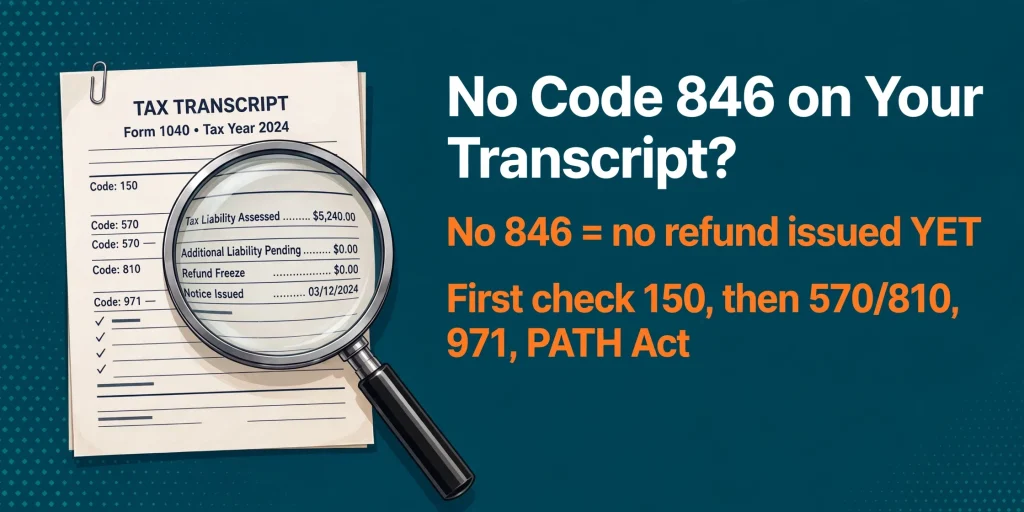
Direct answer: If IRS Code 846 is missing, the IRS has not issued your refund yet — no money has been authorized. The usual reasons: your return is still processing, a hold (570 or 810) froze it, a notice (971) was sent, the PATH Act holds EITC/ACTC refunds, or the balance is $0. Check the diagnostic codes before assuming something is wrong.
You filed, you waited, you pulled your IRS account transcript — and the one code you care about, Code 846 (“Refund Issued”), is nowhere to be found. The first thing to know: a missing 846 is a *status*, not a verdict. It simply means the IRS has not reached the refund step yet. The second thing to know: the rest of your transcript already tells you *why*, if you read it in the right order. This guide is that order — a diagnostic walkthrough that takes you from “is my return even posted?” through holds, notices, offsets, and special timing rules, ending with a clear timeline for when an absent 846 actually becomes a problem.
For the full catalog of transcript entries these codes sit alongside, see our pillar reference, IRS Transcript Codes: Complete List and Meanings.
Step 1: Is Code 150 Posted? (Your Return May Not Be in the System Yet)
Before diagnosing anything, confirm the IRS has your return at all. Look for Code 150 — “Tax Return Filed.” This is the line that proves your return was received, processed, and posted to the IRS master file, with your computed tax liability beside it. If Code 150 is absent too, your return simply hasn’t posted yet: you may have filed very recently, filed on paper (which takes weeks to transcribe), or your transcript may show N/A, which usually means the return hasn’t hit the master file.
If Code 150 *is* there but 846 is not, your return is in the system and working through the pipeline — most e-filed returns finish within about 21 days, and 846 simply posts at the end. Give it a few days before assuming a problem. If the amount next to Code 150 itself confuses you, IRS Code 150 With an Amount: How to Interpret It explains what that figure really means — it is your computed tax liability, not your refund.
Step 2: Scan for Hold and Notice Codes
If Code 150 is posted and the refund still hasn’t issued, something is pausing the pipeline. Scan your transaction list for these codes, in this order:
| Code to look for | What it means | What to do |
|---|---|---|
| 570 — Additional Account Action Pending | The IRS put your refund on hold for additional review | Wait for a follow-up: 571 (hold released) means processing resumes; see IRS Code 570: Refund Hold Meaning, Timeline & What To Do |
| 810 — Refund Freeze | A harder freeze, often tied to identity verification or refundable-credit review | Respond to any verification request promptly; see IRS Code 810: Refund Freeze |
| 971 — Notice Issued | The IRS sent you a letter or recorded another account action | Watch your mail (and your IRS online account) — the notice, not the code, says what the IRS wants; see IRS Code 971: Notice Issued — Meaning |
| 420 / 424 — Examination | Your return was flagged for examination review | See IRS Code 420 and IRS Code 424; gather records but wait for the letter before sending anything |
| 898 — Refund Offset | Your refund was redirected to a non-IRS debt (child support, defaulted student loans) via the Treasury Offset Program | 846 may still appear for the *remaining* balance; see IRS Code 898: Refund Offset |
| 826 — Credit Transferred Out | Part of your overpayment covered a tax debt for another year | 846 posts only for what is left; see IRS Code 826: Credit Transferred Out |
| None of the above | Your return is simply still processing | Normal for e-filed returns under ~21 days; check Where’s My Refund? for status |
Two notes on this checklist. First, the 570 + 971 pair is the most common “stuck” pattern — the hold plus a notice explaining it — and we cover it in detail in IRS Codes 570 and 971 Together. Second, a transcript balance of $0.00 with no 846 does not mean “no refund” — it means the refund hasn’t been calculated yet. Credits post in stages, and the balance updates as they do.
Step 3: Check the Special Timing Rules
Even a perfectly clean return can sit without an 846 for lawful, scheduled reasons:
- PATH Act hold (EITC / Additional Child Tax Credit): By law, the IRS cannot issue refunds on returns claiming the Earned Income Credit or the Additional Child Tax Credit before mid-February, no matter when you filed. If your transcript shows Code 768 (EIC) or an ACTC-related 766, a missing 846 in January or early February is expected — the hold lifts after the statutory date. See IRS Code 768: Earned Income Credit for the details.
- Amended return: If you filed Form 1040-X, your transcript carries Code 977, and amended returns follow a much longer track — the IRS guidance is to allow 8–12 weeks, and up to 16 weeks. No 846 for months on an amended return is normal. See IRS Codes 971 and 977 Together: Amended Return Explained.
- Cycle code rhythm: Weekly-cycle accounts (cycle codes ending 05) update less often than daily accounts, so 846 can appear days later for otherwise identical returns. Our IRS Cycle Code guide explains how to read yours.
Step 4: The When-to-Worry Timeline
Use this table against your filing date — not against the date you first checked your transcript:
| Time since filing | What’s normal | Action |
|---|---|---|
| Under 21 days (e-filed) | Still processing; 846 absent is expected | Wait; check Where’s My Refund? weekly, not hourly |
| 21 days – 6 weeks (e-filed) | Usually a hold or notice is in play | Run the diagnostic checklist above; respond to any 971 notice immediately |
| Paper return, under 6 weeks | Manual transcription; still normal | Wait; paper takes substantially longer than e-file |
| Beyond 6 weeks (e-filed), no 570/810/971 | Unusual — processing should have completed or flagged | Call the IRS; have your transcript codes ready |
| Beyond 6 weeks with 570/810 and no 571/811 | Hold is unresolved; may need your response | Check for a notice; if none arrived, contact the IRS — don’t let the hold sit silently |
The IRS’s ten things to know about tax refunds page reinforces the core point: the IRS cautions against relying on a specific date, and most delays trace to one of the diagnostic codes above rather than a lost return.
Mistakes That Make a Missing 846 Worse
While you wait, avoid these — each one turns a routine delay into a real problem:
- Calling the IRS before the normal window. Under 21 days for e-file (6 weeks for paper), agents can only tell you what your transcript already says: it’s processing. Save the call for when you’re past the timeline with no explanatory code.
- Filing a second “original” return. If you think the first one got lost, do not refile the same return — duplicate filings freeze both and add months. Confirm with Where’s My Refund? or the IRS first.
- Ignoring a 971 notice. The number one way a 2-week hold becomes a 6-month hold is letting the IRS’s letter sit unopened. Open it, read what it asks, respond by its deadline.
- Trusting third-party “refund date” estimators. Only Code 846 on your own transcript and the IRS Where’s My Refund? tool reflect your account. Estimator sites guess from averages.
- Assuming a blank/N/A transcript means rejection. N/A usually means the return hasn’t posted to the master file yet — especially early in the season or shortly after filing. It is a timing artifact, not a rejection.
- Paying anyone who promises to “release” your refund. Refund-release scams spike during delays. The IRS never charges a fee to issue your refund, and no third party can speed up the transcript codes.
Once 846 Appears: What Happens Next
When Code 846 finally posts, the waiting changes character. The date next to it is the IRS’s refund authorization date — not the day money lands in your account. Direct deposit typically follows within 1–5 business days; paper checks take 7–10 business days or more by mail. If the date comes and goes without money, the protocol is bank first, then IRS. Our full walkthrough is IRS Code 846 With a Future Date: When Will You Get Your Refund?.
If reading the transcript line by line is new to you, our How to Read an IRS Account Transcript: Step-by-Step Guide covers every section, and Tax Refund Status: Check Your Federal and State Refund shows how to track live status alongside the transcript.
Related Guides
- IRS Transcript Codes: Complete List and Meanings
- IRS Code 846: Refund Issued
- Tax Refund Status: Check Your Federal and State Refund
- How to Read an IRS Account Transcript: Step-by-Step Guide
Frequently Asked Questions
Does no Code 846 mean my refund was denied?
No. A missing 846 means the IRS has not *issued* your refund yet — it says nothing about denial. Denial or reduction would show up as other codes (offsets like 898/826, or adjustment codes like 290/291). The most common reasons for a missing 846 are normal processing time, a 570/810 hold, or the PATH Act hold on EITC/ACTC refunds.
How long should I wait for Code 846 to appear after filing?
For most e-filed returns, processing completes within about 21 days, and 846 posts at the end of that window. Paper returns take substantially longer — allow at least 6 weeks before treating a missing 846 as unusual. Amended returns (Form 1040-X, Code 977) run 8–12 weeks or more.
I see Code 570 but no 846. What does that mean?
Code 570 means the IRS paused your refund for additional review — so 846 cannot post until the hold is resolved. Watch for a follow-up Code 571 (hold released), which usually precedes 846, or a Code 971 notice explaining what the IRS wants. See IRS Code 570: Refund Hold Meaning, Timeline & What To Do for the full breakdown.
My transcript balance shows $0.00 and there’s no 846. Is my refund gone?
No — a $0.00 balance with no 846 means your refund hasn’t been calculated yet, not that it is zero. The transcript is a ledger of posted actions: until your credits (806 withholding, 766/768 credits) post against Code 150’s liability, the balance sits at zero. The number becomes meaningful only after the processing codes are in place.
Could the PATH Act be why I have no Code 846?
Yes, if you claimed the Earned Income Credit or the Additional Child Tax Credit. Federal law bars the IRS from issuing those refunds before mid-February, regardless of when you filed — so a January or early-February transcript with Code 768 and no 846 is exactly what the law requires. The hold lifts after the statutory date; see IRS Code 768: Earned Income Credit.
When should I actually call the IRS about a missing 846?
Call when you’re past the normal windows with no explanatory code: more than 21 days for an e-filed return (6+ weeks for paper) with Code 150 posted but no 570, 810, 971, or PATH Act reason on the transcript. Before calling, note your exact codes and dates from the transcript — and check Where’s My Refund? first, since agents will ask what it shows.
*Disclaimer: This article is for general information only and is not tax advice. Transcript codes reflect IRS processing actions and can change with your specific facts. For questions about your account, consult a qualified tax professional or contact the IRS directly.*